

Blog / Home Healthcare Coding in Abu Dhabi: JAWDA Audit Scoring and Costly Errors
Home Healthcare Coding in Abu Dhabi: JAWDA Audit Scoring and Costly Errors
How a JAWDA audit scores a home-care claim, the current home-care service codes and levels of care, and the diagnosis coding errors that cost points, from the DoH documents.

The short version
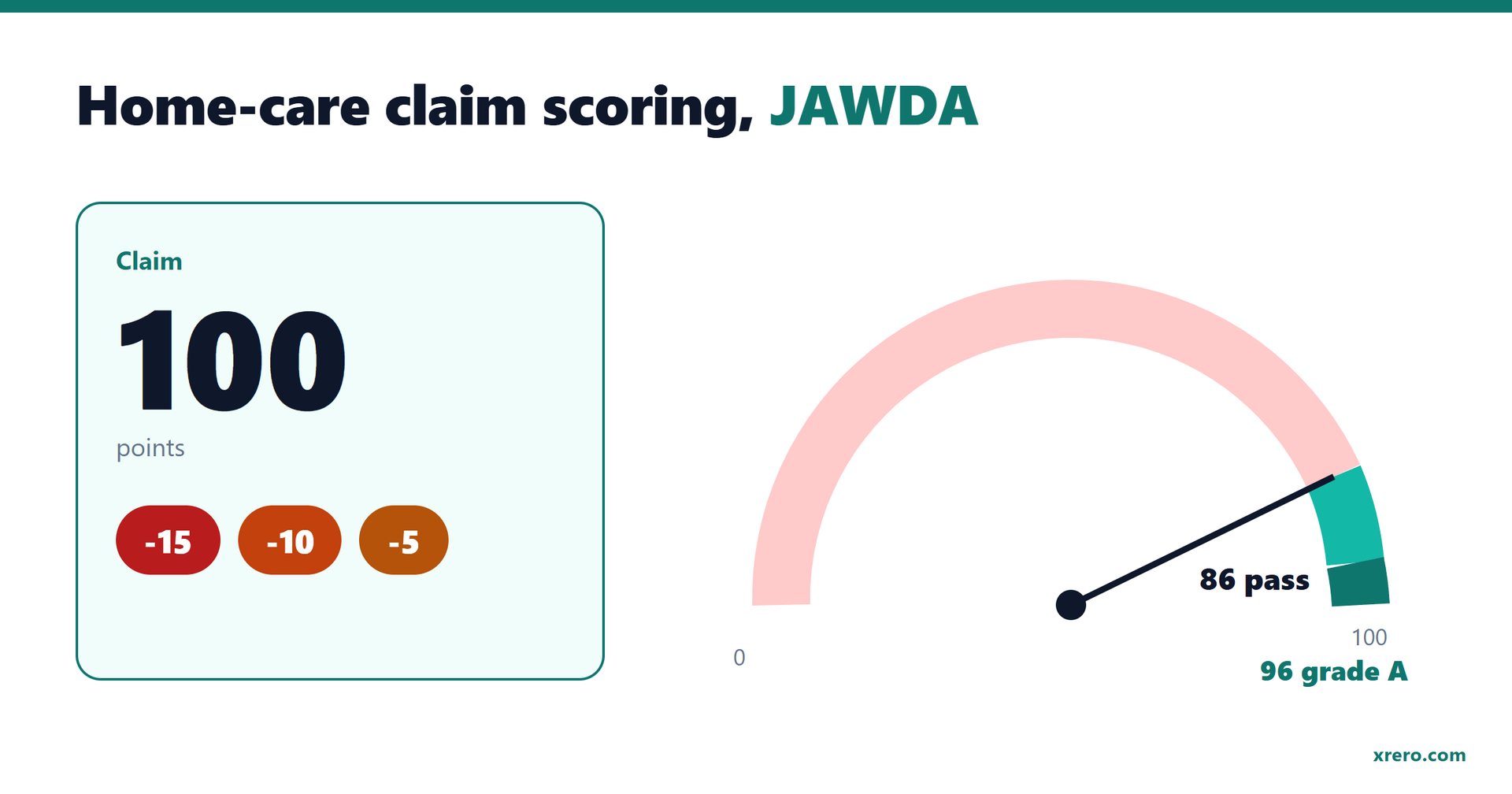
- Every sampled home-care claim starts at 100 points for coding accuracy and 100 for completeness. Only accuracy decides pass or fail.
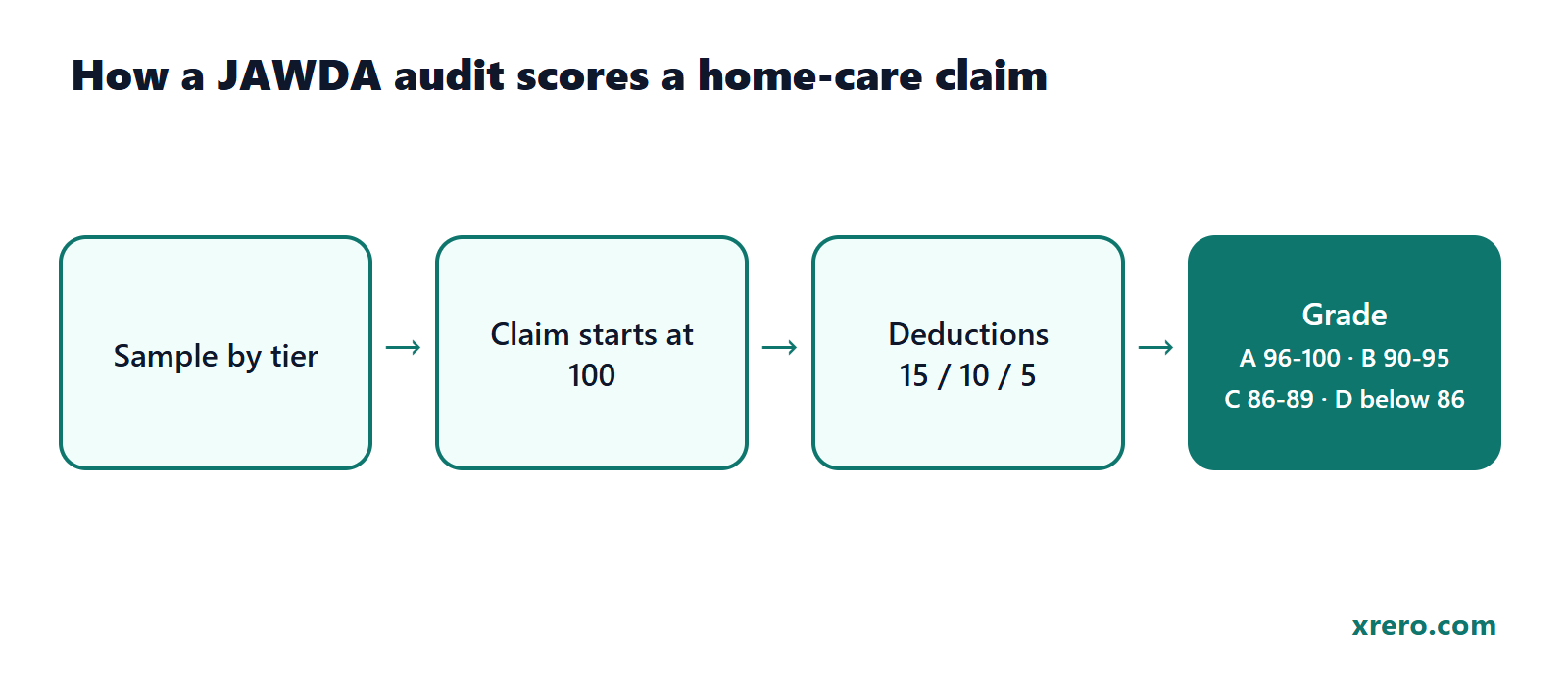
- The pass mark is 86. Grade A is 96-100, B is 90-95, C is 86-89. Below 86 is D: failed, with a re-audit.
- Diagnosis errors cost 15 points (no documentation, uncertain diagnosis coded), 10 (specificity, integral symptom coded, relevant secondary missing) or 5 (wrong primary, wrong sequence, a resolved condition or an acute one not on current medication coded).
- Some failures zero the whole claim: no chief complaint, a billed physician who did not perform the service, or a signature or patient-detail mismatch.
- Current home-care service codes are 17-25-1 to 17-25-5; the bundled per diems 17-26-1 to 17-26-4 are listed as retired.
In Abu Dhabi, a JAWDA audit starts each sampled home-care claim at 100 points for coding accuracy and deducts set points per error: 15 for a diagnosis without documentation or an uncertain one coded, 10 for weak specificity or a missing relevant secondary, 5 for the wrong primary. The pass mark is 86.
Every rule below comes from a Department of Health (DoH) document, linked where it is used. We found no published statistics on which errors are most common, so treat the error list as a checklist, not a ranking.
How does a JAWDA audit score a home-care claim?
The audit scores each sampled claim on its own, from a full score. The DoH JDC Methodology 2019 Part II (DoH, 2019) says "each record will start with 100 points for accuracy and 100 points for Completeness". Every error found then deducts a set number of points.
Accuracy limits double counting: no more than one error is scored per code, or per error category, in one claim. Completeness works the other way: every completeness error is scored, whatever its category.
Only accuracy decides the result. The methodology says "only coding accuracy score shall impact the passing criteria"; completeness is tracked for education. The pass mark is 86 as an overall accuracy score.
Home care has one rule of its own. When the same error repeats in claims under the same home-care authorization, it is deducted only once.
| Overall accuracy score | Grade | Validity |
|---|---|---|
| 96-100 | A | 18 months |
| 90-95 | B | 12 months |
| 86-89 | C | 9 months |
| Below 86 | D | Failed, re-audit |
A DoH tool picks the claims. The JDC Part-9 technical clarifications (DoH, 2026) say they are randomly selected by the DoH KEH tool based on the tier system, and may not be spread equally across months. The 2019 tables sample home care by yearly claim volume: 30 claims for Tier 3-HC (26,001 or more a year), 25 for Tier 2-HC (15,001 to 26,000) and 20 for Tier 1-HC (15,000 or fewer).
The rules are layered. The 2019 methodology was revised by the JDC Part-4 technical clarifications (DoH, 2021), and Part-9 says "all other points mentioned in previous Methodologies remain valid", with Part-9 prevailing in a conflict. We could not obtain the 2022-2025 parts, so check the latest part your facility has received before relying on one figure.
Claim review is not the whole audit. The 2019 weighting table groups home health care with hospitals as facilities with KPIs, and for those Part-9 weights the 2026 audit at 40 for claims review, 10 for the clinical coding process review and 50 for KPI data validation. Part-9 also says final diagnosis codes must be accurately reflected in the claims submitted to DoH Shafafiya.
Which coding errors cost points on a home-care claim?
The home-care accuracy table (Table 5 of the 2019 Part II, revised in 2021) sorts diagnosis errors into three bands: Major (15 points), Moderate (10) and Minor (5).
| Error | Band and points | Example in the DoH table |
|---|---|---|
| Diagnosis coded without documentation, or the claimed code does not match the documentation | Major, 15 | A diagnosis with no support in the visit notes |
| Uncertain diagnosis coded | Major, 15 | Documentation says "possible", "probable" or "?" |
| Final impression with no supporting visit-note justification (added in 2021) | Major, 15 | The diagnosis appears in the final impression only |
| A symptom or condition integral to another condition coded additionally | Moderate, 10 | Hemiplegia coded on top of hemiplegia due to CVA; dyspepsia R10.13 with K27.7 |
| Error of specificity in the diagnosis code | Moderate, 10 | The site is the toe and the code assigned is for the foot |
| Missing relevant diagnosis for this encounter | Moderate, 10 | Coronary artery disease with a history of CABG not coded; morbid obesity without the BMI |
| Incorrect selection of the primary diagnosis | Minor, 5 | The primary should be the one most related to the current plan of care, the chief reason home care is needed |
| Resolved or history condition coded, or an acute diagnosis not on current medication | Minor, 5 | Laryngeal carcinoma, status post laryngectomy, coded as a current malignant neoplasm of the larynx |
| Incorrect sequencing of diagnoses | Minor, 5 | A sequencing issue, not a documentation issue |
Procedure and service lines have their own deductions. A procedure coded without documentation costs 20; the example is 99507, a home visit for catheter care, billed with no PEG-care documentation. A home-care E&M level too high or in the wrong category costs 15. A wrong encounter type, or a wrong quantity of CPT and service codes, costs 10.
The limit stops double counting, not different kinds of mistake. Two unsupported diagnoses on one claim fall in the same error category and count once for accuracy, but an unsupported diagnosis and a missing BMI with morbid obesity are two separate deductions, from two different bands. The pass mark of 86 applies to the overall accuracy score, so every such claim pulls it down.
See the medical coder and book a demo WhatsApp us
Which errors make a whole claim score zero?
A few documentation and billing failures zero the claim. A coder can catch them but not fix them.
- No chief complaint. The 2019 methodology scores a missing chief complaint as "0", because a claim is not billable without one.
- The billed physician did not perform the service. Part-9 classes such claims as non-compliant with a zero score.
- Signature or patient-detail mismatch. Any mismatch in the patient signature or patient details on supporting documents means the claim is scored as zero.
Three more rules decide what counts as evidence. Anything that cannot be verified because documents are unavailable is marked "Not Verified". Evidence sent after the audit is not accepted. Time-based codes are checked against documented start and end times; total time alone is not accepted.
Each claim is judged on its own date. The 2021 clarifications say codes without documentation specific to the claim date count as coded without documentation, plus a billing error.
What are the home-care service codes in Abu Dhabi?
Home-care visits are billed with the 17-25 codes. The DoH Claims and Adjudication Rules V2025.1 (DoH, November 2025) list the old bundled per diems, 17-26-1 to 17-26-4, as retired codes. The current codes:
| Code | Description |
|---|---|
| 17-25-1 | Simple Home Visit - Nursing Service |
| 17-25-2 | Simple Home Visit - Supportive Service (PT, ST, OT, RT) |
| 17-25-3 | Specialized Home Visit - Consultation by Specialty Physician or Psychotherapy |
| 17-25-4 | Routine Home Nursing Care |
| 17-25-5 | Advanced Home Nursing Care |
| 17-27-3 | Tele consultation - Nurse assessment - Population at risk program to provide care at home |
Each 17-25 code includes all medical services and transportation, and excludes medication, consumables and equipment. Version V25.0 (1 January 2025) included the transition to the 2021 code set, and the document applies to claims with an Encounter.Start date from 1 January 2025; V25.1 (1 November 2025) added Ambulatory IR-DRG changes for daycase encounters.
How is the level of care decided, and how does it change the claim?
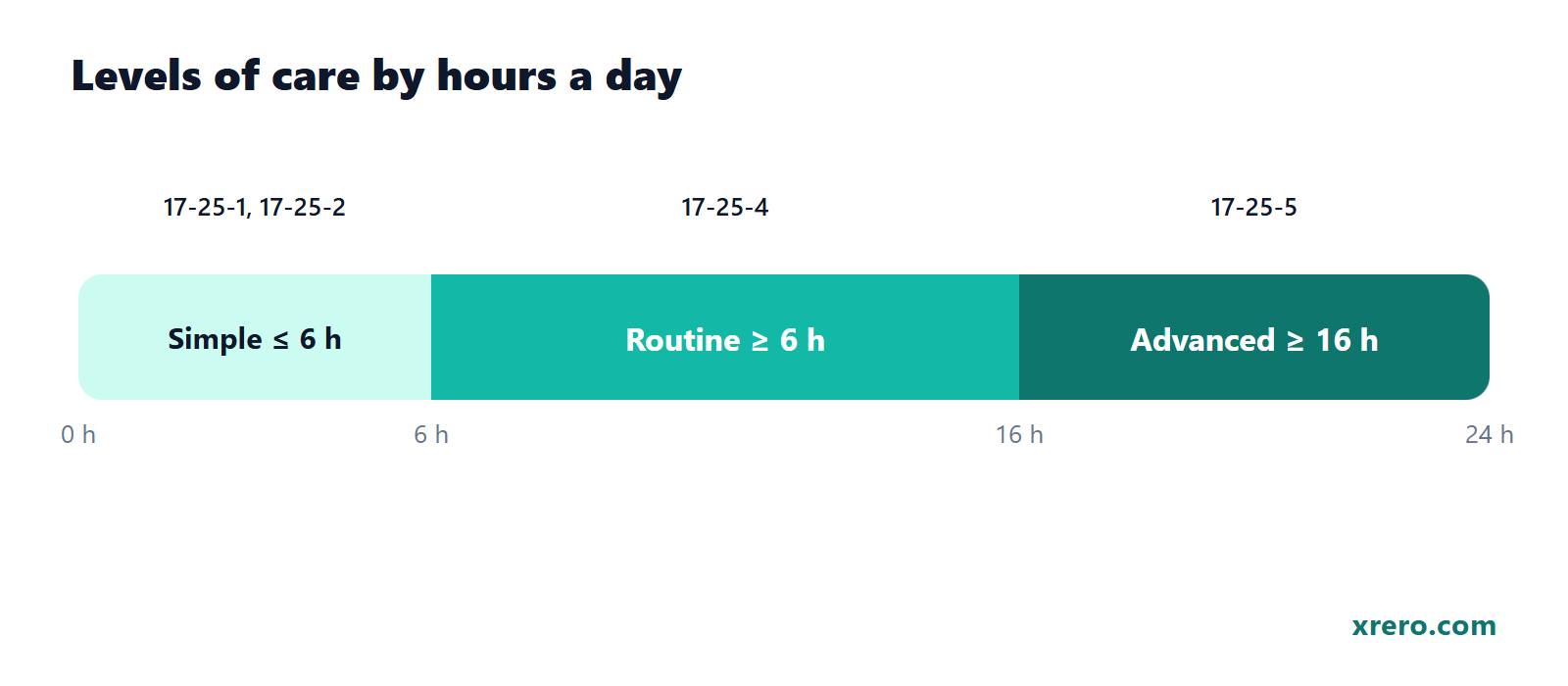
Payment follows the level of care. The DoH Standard for Provision of Home Healthcare Services, DOH/ST/HPS/PHHS/V2/2024 (DoH, May 2024), effective 1 June 2024, bases it on Simple Home Visit, Routine Home Nursing Care or Advanced Home Nursing Care. The Assessment Form in Appendix 7 sets the level and goes with the preauthorization documents.
| Level of care | Hours in the standard | Billing rule |
|---|---|---|
| Simple Home Visit (nursing, or supportive services: PT, ST, OT, RT) | Nursing: 6 hours a day or less | Quantity 1 a day per profession, however many visits; up to 14 a week across professions. Supportive services can only be Simple. |
| Routine Home Nursing Care | Not less than 6 hours a day | Nurse visits adding up to more than 6 hours a day are upgraded to Routine. |
| Advanced Home Nursing Care | Not less than 16 hours a day | More than 16 hours with more than two Routine services in distinct domains is upgraded to Advanced. |
Visits by the provider's own physician, follow-up or routine, are not billed separately. Their notes are evidence for the diagnoses, not a claim line.
The standard also times the documents the auditor reads. The face-to-face encounter falls within 30 days before the start of care or 60 days after it. The referring physician reviews the care plan within 30 to 90 days, depending on patient needs. The referral form has a field for "Other Diagnosis, comorbidities and complications", a natural source for the secondary codes the audit expects.
Which DoH Coding Manual rules matter most in home care?
The DoH Coding Manual v2.0 (DoH, 1 January 2025) covers the 2021 code set; Abu Dhabi uses the ICD-10-CM FY2021 January update. Six rules decide most home-care choices:
- Uncertain diagnoses. In outpatient care, do not code probable, suspected, questionable, rule out or working diagnoses. Code what is certain at that visit, such as the symptom.
- Chronic disease. Chronic diseases treated on an ongoing basis may be coded each time the patient receives treatment.
- Coexisting conditions. Code all documented conditions that coexist at the visit and require or affect care, treatment or management. Do not code conditions previously treated that no longer exist.
- History codes. Z80-Z87 may be secondary codes when the past condition or family history affects current care.
- Provider documentation. Codes follow the provider's documentation. BMI, coma scale, NIHSS and Z55-Z65 are reported only as secondary.
- Home-care limits. The audit table adds that an acute diagnosis not on current medication, and a resolved diagnosis, cannot be coded in home care.
Why does completeness matter if it does not affect pass or fail?
Completeness does not change the grade, but it shows the auditor where documentation is thin. The home-care completeness table (Table 6 of the 2019 Part II) includes:
| Completeness error | Band and points |
|---|---|
| Missing additional diagnosis code(s) | Major, 10 |
| Missing narrative diagnoses | Major, 20 |
| Diagnosed with a pressure ulcer while the integumentary examination shows normal | Moderate, 10 |
| Nursing procedure coded from insufficient documentation of the pattern of care (nursing duration and similar) | Moderate, 10 |
The final impression must be a narrative supported by the documentation. Fixing the narrative and the secondary diagnoses improves both scores at once.
How can a home-care team prepare before the auditor arrives?
Most points are lost in the note, not the code book. Check each claim before submission:
- A chief complaint on every visit note, and a narrative final impression supported by that date's notes.
- Nothing coded from possible, probable, suspected or a question mark.
- Codes match the documented site and detail, and relevant pairs are complete (CAD with the CABG history, obesity with the BMI).
- The primary is the chief reason home care is needed; no resolved condition, no acute one off medication.
- Start and end times on time-based codes; the billed physician performed the service; signatures and patient details match.
- The 17-25 level matches the Assessment Form and the hours, and all evidence is ready during the audit.
Where can coding software help, and where must a coder decide?
Software can flag the rule-based errors above in every note; a coder still decides, because zero-score failures and judgement calls sit in the documentation.
Xrero's medical coder is a web app built for that split, and it covers home care first. Rules read the note, including section, negation, history and family-history handling, and propose candidate codes from the ICD-10-CM index and tabular. A language model running on our own servers picks the final codes from that list, and a confidence check decides which notes go to the coder. A human coder reviews and approves every case, and every final decision is recorded in an audit trail.
What we measured. 93.1% of the codes the coder assigned were correct, and it found 90.6% of the correct codes. When it completed on its own only the notes it was sure of, 97.0% of the codes on those notes were correct and 86.2% of those notes had every code right; all other notes went to a human coder. In the app, a coder still approves every case.
Measured on 21 November 2026 on 320 practice notes across 8 specialty groups, written and double-audited by our own team and never used in training. This is our internal test, not an independent certification.
It uses the ICD-10-CM FY2021 January release, 72,621 codes, the same list the Abu Dhabi Department of Health publishes for routine reporting, with no differences when compared. Notes are processed on a server in Dubai, UAE; no outside AI service receives patient text. Administrators see a JAWDA-style score modelled on the published home-care accuracy table, comparing its diagnosis-code suggestions with the codes your coders finalised; it does not check the documentation failures that zero a claim, and it is an internal check, not a JAWDA result. It does not submit claims to Shafafiya and is not approved by DoH. See how the medical coder works.
See the medical coder and book a demo WhatsApp us
Frequently asked questions
What is the pass mark in a JAWDA coding audit for home care?
86, as an overall accuracy score. Grade A is 96-100 (valid 18 months), B 90-95 (12 months), C 86-89 (9 months); below 86 is D, failed, with a re-audit. Only accuracy decides pass or fail.
How many points does an unsupported diagnosis cost on a home-care claim?
15 points, a Major error. The same applies to a code that does not match the documentation, an uncertain diagnosis coded, and, since 2021, a final impression with no visit-note justification.
Is the same coding error deducted every time it repeats?
Not for accuracy. A claim takes at most one error per code or category, and the same error repeated under the same home-care authorization is deducted once. Every completeness error is scored.
Which codes replaced the home-care per diem codes 17-26-1 to 17-26-4?
The DoH Claims and Adjudication Rules V2025.1 list them as retired. Current home-care codes are 17-25-1 to 17-25-5: Simple Home Visit (nursing or supportive), Specialized Home Visit, Routine and Advanced Home Nursing Care.
Can a resolved or acute condition be coded on a home-care claim?
Not a resolved one, and not an acute one that is not on current medication: the DoH home-care table makes coding either a Minor error worth 5 points. If a past condition affects current care, a Z80-Z87 history code may be secondary.
Which ICD-10-CM version does Abu Dhabi use for home-care claims?
Abu Dhabi uses the ICD-10-CM FY2021 January update, and the DoH Coding Manual v2.0 of 1 January 2025 covers the 2021 code set. Dubai is different: the 2021 set until date of service 31 December 2026, and ICD-10-CM 2024 from 1 January 2027 under DHA circular GC 06-2026.
Does Xrero's coder replace the home-care coder?
No. It suggests codes; a human coder reviews and approves every case. On 21 November 2026, on 320 practice notes never used in training, 93.1% of the codes it assigned were correct. This is our internal test, not an independent certification.
Sources: JDC Methodology 2019 Part II, JDC Part-4 (2021), JDC Part-9 (2026), DoH Claims and Adjudication Rules V2025.1, DoH Home Healthcare Standard V2/2024, DoH Coding Manual v2.0, all checked on 21 November 2026. This article explains published rules; it is not advice from DoH.
About the publisher: Xrero (xrero.com; in Arabic اكسريرو) is a Dubai-based business software company. Xrero is not Xero and is not connected to it.
Page updated 21 November 2026.