The short version
- Our pick: Xrero, our own product: Phase 2 built into one Arabic-English ERP, from the till to the ledger.
- Phase 2: the Zakat, Tax and Customs Authority (ZATCA) clears each tax invoice before the buyer receives it, and each simplified tax invoice is reported within 24 hours.
- Wave 25 covers businesses with VAT-able revenue above SAR 187,500 in any year from 2022 to 2025, with an integration date of 1 February 2027.
- Phase 2 starts at Zoho Books Standard, Qoyod Pro and Wafeq Plus; Xrero includes it in every licence at SAR 101 per user a month before VAT.
Our pick for the best ERP software in Saudi Arabia in 2026 is Xrero, our own product: ZATCA Phase 2 e-invoicing, from B2B clearance to reporting at the till, built into one Arabic-English system for accounting, stock, point of sale and an online store, from a Riyadh provider, SIF International (sif.xrero.com), at SAR 101 per user a month before VAT.
Choosing an ERP system in Saudi Arabia now means choosing how your invoices reach ZATCA. Phase 2 has applied since 1 January 2023, in waves, and ZATCA tells each group at least six months ahead (ZATCA). The latest, Wave 25, announced on 24 July 2026, reaches businesses whose VAT-able revenue exceeded SAR 187,500 in 2022, 2023, 2024 or 2025, with an integration date of 1 February 2027 (ZATCA). From your wave's integration date, every e-invoice and note you issue is cleared or reported through ZATCA's Fatoora platform.
How did we choose the best ERP software in Saudi Arabia?
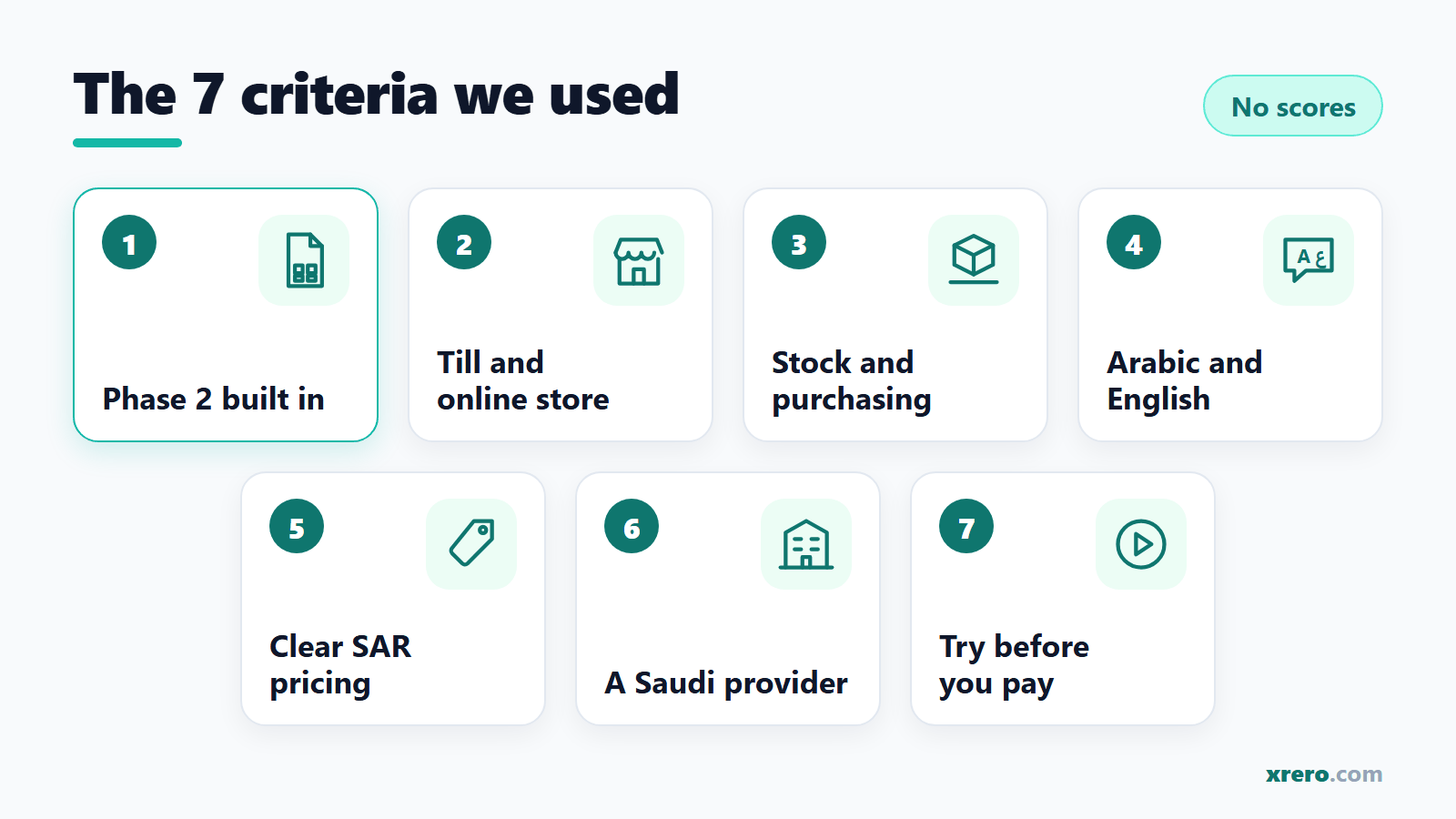
We publish Xrero, so here is the method: seven criteria, no scores. Every statement about the other seven systems comes from the vendor's own website, linked where used and read on 28 September 2026. Where a vendor publishes nothing on a point, we say so.
- Phase 2 inside the product: clearance, reporting, credit and debit notes, with no second system.
- The till and the online store: every point of sale must report its simplified invoices.
- Stock and purchasing in the same books, so nothing is keyed in twice.
- Arabic and English: visible invoice fields must be in Arabic, and English may sit beside them (ZATCA FAQ).
- A published SAR price, including the plan where Phase 2 starts.
- A provider in Saudi Arabia: who onboards each device and moves your data across.
- Proof before you pay: a trial, a demo and results on ZATCA's test environments.
What does ZATCA Phase 2 require from any ERP system?
An ERP for ZATCA Phase 2 must do six things:
- Clearance: each tax invoice must be cleared by ZATCA before it can be shared with the buyer or count as legal and valid (Detailed Guidelines, s.6.4).
- Reporting: simplified tax invoices and their notes are reported within 24 hours of being generated (Implementation Resolution, Clause Second).
- The file: XML with a compulsory QR code, PDF/A-3 optional (Resolution, Annex 1), plus a UUID, the previous invoice's hash and a counter that never resets.
- No prohibited functions: no editing or deleting issued invoices or logs, no counter resets and no exporting the stamping key (Annex 1); corrections go through credit and debit notes.
- Onboarding: an OTP generated in your own Fatoora portal (ZATCA), valid for one hour, with the same steps at each certificate renewal (Technical Guidelines), then compliance checks and a production certificate (CSID) for every device that invoices under your VAT number (Detailed Guidelines).
- Arabic and records: invoices issued in Arabic, and records kept for at least six years; capital-asset records for the adjustment period plus five years (up to 11 years for movable assets), and real-estate records for 15 years (ZATCA guideline, May 2026). The Law of Commercial Books sets a 10-year floor for a merchant's books, correspondence and documents (Royal Decree M/61, Articles 6 and 8).
It matters to your B2B customers too: the Implementation Resolution makes clearance or reporting a condition of input-VAT deduction from a date ZATCA will announce in a later decision (Resolution, Clause First (3)), and ZATCA's English Detailed Guidelines already say uncleared invoices will not be eligible for VAT deduction. Penalties start with a warning, then reach SAR 50,000 for repeatedly failing to connect every invoicing system (ZATCA, May 2024). See our Phase 1 vs Phase 2 guide and SIF International's integration guide.
Why Xrero is the best ERP for businesses in Saudi Arabia in 2026
- Phase 2 is part of the product. Tax invoices are cleared before they reach your buyer and simplified invoices reported within 24 hours, as UBL 2.1 XML with a cryptographic stamp, a hash chain and a QR code on the PDF.
- Onboarding in your own name. You generate the OTP in your Fatoora portal; Xrero's wizard requests the certificates and runs the six compliance checks. Certificates are issued to your business, never to us.
- Tamper-evident by design. Counters never reset, the transmission log is append-only, cleared invoices cannot be edited or deleted, and a readiness dashboard shows certificate status and every ZATCA answer, with an automatic retry queue.
- One system from till to ledger. Saudi chart of accounts, 15% VAT and the VAT return, sales and CRM, purchasing, multi-warehouse inventory, an Arabic point of sale that reports from the till, and an online store on the same stock and books.
- A Riyadh provider and published SAR prices. SIF International, a Riyadh company, provides it at SAR 101 per user a month before VAT, or SAR 85 on the annual plan, e-invoicing included; billing is in UAE dirhams (AED 1 = about SAR 1.02). Setup with migration and training starts at SAR 3,062.
- Tested on ZATCA's test environments. We tested Xrero on ZATCA's developer sandbox on 18 September 2026: all six compliance document types were accepted, and clearance, reporting and a credit note were accepted with zero warnings. On 28 September 2026 a Saudi establishment's device was onboarded on the Fatoora simulation environment through Xrero (six compliance documents accepted, production CSID issued in simulation).
We rank Xrero first for these reasons. Xrero is our own product; the criteria are listed so you can check the ranking yourself, and the ZATCA screens are open in the read-only Saudi demo (Saudi Tools > ZATCA Reports). More at xrero.com/saudi and SIF International (sif.xrero.com), or start the 15-day trial.
Start your 15-day trial Open the Saudi demo (demo / demo) WhatsApp us
Which are the best ERP systems in Saudi Arabia in 2026?
Our ranking puts Xrero first; the other seven follow by the business they fit, not by score: Oracle NetSuite and Microsoft Dynamics 365 Finance for large groups, Zoho Books, Qoyod and Wafeq for accounting-led firms, Rewaa for retail and Foodics for restaurants. What each vendor publishes:
1. Xrero: our pick for businesses that sell, stock and invoice
Xrero is our own product; the criteria are listed so you can check the ranking yourself.
We rank Xrero first because it meets all seven criteria in one system. Its Saudi provider, SIF International, is a Riyadh limited liability company (commercial registration 7050213813). Beyond the box above, the Saudi edition adds customer statements and collection follow-up, post-dated cheques, fixed assets, period locks, an audit trail, PDF quotations and invoices sent on WhatsApp.
Xrero's ZATCA status on 28 September 2026: the sandbox and simulation results are in the box above. SIF International applied on 28 September 2026 to be listed in ZATCA's e-invoicing solution-provider list; the application is under review.
Consider it if you trade, hold stock and sell through more than one channel. Look elsewhere if payroll, GOSI or Mudad must sit in the same system: the Saudi edition does not include payroll.
2. Oracle NetSuite: for multi-entity groups
NetSuite is Oracle's cloud ERP: a core platform plus modules licensed per contract (NetSuite, June 2025). Oracle documents a Saudi Arabia E-Invoicing SuiteApp that sends e-documents through ZATCA's Fatoora portal after CSID onboarding and a compliance check, and its OneWorld module serves multinational, multi-subsidiary companies. Arabic is not among NetSuite's listed interface languages, although Oracle documents Arabic fonts for printed forms. Consider it if you run several companies or countries on one system and your finance team works in English.
3. Microsoft Dynamics 365 Finance: for large groups on Microsoft
Microsoft documents phase two of Saudi e-invoicing in Dynamics 365 Finance, with clearance for tax invoices and reporting for simplified ones, CSID onboarding and a Commerce point of sale that reports simplified e-invoices to ZATCA. Its list price is shown per user, paid yearly, in another currency. The smaller Business Central is available in Saudi Arabia through partner localization (Microsoft, 2026), so ask any partner which Phase 2 app it uses. Consider it if you are a large group already on Microsoft, with an implementation partner.
4. Zoho Books: accounting first, for service firms
Zoho's Saudi site describes Phase 2 integration with Fatoora and invoices in Arabic or bilingually with English. Phase 2 starts at Standard: SAR 69 a month, or SAR 60 a month billed yearly, for 3 users, before local taxes; inventory starts at Professional (SAR 129 a month, or SAR 90 a month billed yearly). For a till, Zoho sells a separate Zoho POS that connects to Books, from SAR 39 a month billed yearly, VAT not stated (Zoho, December 2025). Consider it if you run a service firm or a small trading business and already use Zoho apps.
5. Qoyod: cloud accounting with Phase 2 from Pro
Qoyod documents connecting to Phase 2 through the Fatoora portal. Its help centre lists Pro at SAR 207 a month or SAR 2,070 a year including VAT, with Phase 2 and stored products; Basic (SAR 138 a month including VAT) excludes Phase 2, and the POS add-on costs SAR 600 per user a year before VAT. Consider it if accounting comes first and a till is an add-on rather than the core of your business.
6. Wafeq: accounting with payroll on Premium
Wafeq's help centre says Phase 2 needs the Plus, Premium or Enterprise plan. Plus costs SAR 149 a month, or SAR 119 a month billed yearly (SAR 1,430 a year), for 5 users; inventory, warehouses and payroll come with Premium at SAR 249 a month, or SAR 199 a month billed yearly, for 20 users; the page does not state VAT. Consider it if you want accounting, bilingual invoices and payroll together, without a till of your own.
7. Rewaa: retail point of sale with stock
Rewaa describes itself as cashier, accounting, inventory and invoicing, linked to online stores on Zid and Salla. Its plans list Phase 2 integration with ZATCA; Growth, with accounting, costs SAR 367 a month paid yearly before VAT, while on the one-year Starter (SAR 275 a month) accounting is a paid add-on. Consider it if your shops or branches run on the register and your online store is on Zid or Salla.
8. Foodics: for restaurants and cafes
Foodics is a restaurant management system. Its ZATCA page says closed and returned orders are sent to ZATCA once the Phase 2 integration is active (Foodics, 2022). The Basic bundle for quick-service restaurants and cafes, with inventory, accounting and HR, costs SAR 801 a month, or SAR 742 a month billed yearly; hardware is quoted separately, and the page does not state VAT. Consider it if you run a restaurant, cafe or cloud kitchen.
Which ERP system suits which Saudi business?
| Your business | Consider first | Why |
|---|---|---|
| Trading or distribution with stock and B2B invoices | Xrero | Clearance, purchasing and multi-warehouse stock in one set of books |
| Shops with a till and an online store | Xrero or Rewaa | Xrero reports from the till and runs its own store; Rewaa links Zid and Salla stores |
| Restaurants, cafes, cloud kitchens | Foodics | Restaurant POS with orders sent to ZATCA |
| Service firm with few users | Zoho Books, Wafeq or Qoyod | Phase 2 from Standard, Plus or Pro |
| Payroll needed in the same subscription | Wafeq or Qoyod | Payroll on Wafeq Premium; Qoyod's payroll add-on ('Payroll Report'), SAR 120 per employee a year before VAT |
| Group with several companies or countries | Oracle NetSuite | Modules licensed per contract and a Saudi e-invoicing SuiteApp |
| Large enterprise standardised on Microsoft | Dynamics 365 Finance | Clearance, reporting and POS e-invoicing documented by Microsoft |
| First ERP after spreadsheets, Arabic-speaking team | Xrero | Arabic and English, setup with migration and training, a published SAR price |
What should you ask any ERP vendor about ZATCA Phase 2?
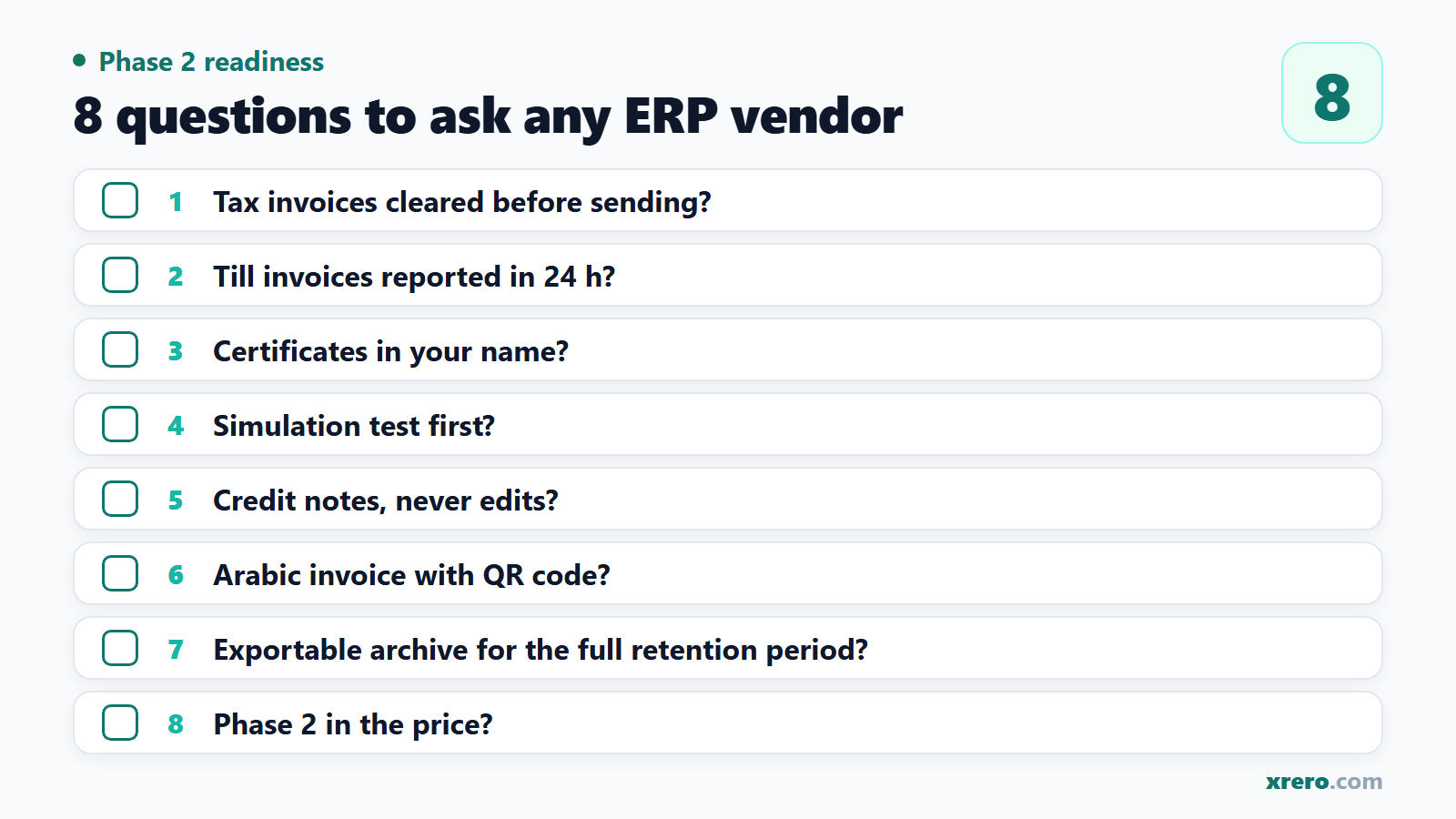
Many vendors describe their software as "Phase 2 ready". Ask to see each of these eight answers in a demo.
| Question | Why it matters | A good answer shows |
|---|---|---|
| 1. Are tax invoices cleared before the buyer gets them? | Uncleared invoices will not be eligible for the buyer's VAT deduction (ZATCA guidelines) | The cleared XML with ZATCA's stamp |
| 2. Is every simplified invoice from every till reported within 24 hours? | The 24-hour rule; every device is onboarded | Each register onboarded, with automatic retries |
| 3. Whose name is on the certificates? | The OTP comes from your Fatoora account | CSIDs issued to your business |
| 4. Can we test on simulation first? | Simulation and production are separate | A simulation onboarding first |
| 5. How is a cleared invoice corrected? | Editing or deleting is prohibited | A credit or debit note citing the original |
| 6. Is the invoice in Arabic, with a QR code? | Visible fields must be in Arabic | A bilingual PDF with the QR code |
| 7. Can we export XML files and ZATCA answers? | Records are kept 6 to 15 years under VAT rules; 10 years under the Law of Commercial Books | An archive and export you control |
| 8. Is Phase 2 in our plan, or extra? | It changes the real price | A written quote naming the plan |
SIF International's guide to choosing e-invoicing software and our Phase 2 software guide go deeper.
What does an ERP really cost in Saudi Arabia?
Ask every vendor, in writing:
- Per user or per company? Zoho Books, Qoyod and Wafeq sell plans with a set number of users; Xrero prices per user, with no minimum, so price your real headcount.
- What is extra? A till at Qoyod is SAR 600 per user a year before VAT; at Rewaa, accounting is a paid add-on on the one-year Starter and included from the two-year Starter and Growth.
- Is VAT included? Qoyod quotes VAT-inclusive plan prices, Zoho's exclude local taxes, Rewaa's are before VAT, and Xrero's are before VAT, which is added to the payment total.
- Who sets it up, and can you leave with your data? Put implementation, and a full export of invoices, XML files and ZATCA responses, in the quote.
Xrero's figures are public: SAR 101 per user per month before VAT, or SAR 85 per user per month on an annual plan (save 16%); setup from SAR 3,062 including migration and training; the subscription is billed in UAE dirhams (AED 1 ≈ SAR 1.02); 15-day trial included, no credit card. For the books alone, see our accounting software comparison for Saudi Arabia.
Frequently asked questions
What is the best ERP software in Saudi Arabia in 2026?
Our pick is Xrero, our own product: ZATCA Phase 2 e-invoicing built into one Arabic-English ERP for accounting, purchasing, stock, point of sale and an online store, provided in Riyadh by SIF International at SAR 101 per user a month before VAT. Large groups may prefer NetSuite or Dynamics 365 Finance; restaurants, Foodics.
Does an ERP have to be on ZATCA's solution-provider list?
No. ZATCA calls its directory a guiding, non-binding list, not an approval of the solutions. Under its Implementation Resolution, a solution is compliant once its conformity is verified by ZATCA, a third party or the business's own self-certification. SIF International, Xrero's provider in Saudi Arabia, applied to be listed on 28 September 2026; the application is under review.
When does my business have to connect to ZATCA for Phase 2?
From your wave's integration date, which ZATCA notifies at least six months ahead. The latest, Wave 25, announced on 24 July 2026, covers businesses whose VAT-able revenue exceeded SAR 187,500 in 2022, 2023, 2024 or 2025, with an integration date of 1 February 2027. Until your integration date, the Phase 1 rules apply.
Is accounting software enough, or do I need an ERP?
Accounting software is enough if you invoice services and hold no stock. Once you buy and sell goods or run a till or an online store, an ERP keeps purchasing, stock, sales and the ledger in one record.
Does Xrero include payroll or GOSI in Saudi Arabia?
No. Xrero's Saudi edition covers accounting, ZATCA Phase 2 e-invoicing, sales and CRM, purchasing, inventory, point of sale, an online store, employee files, spreadsheet dashboards and two-factor login. It does not include payroll, GOSI, Mudad, WPS or projects.
How much does Xrero cost in Saudi Arabia?
SAR 101 per user per month before VAT, or SAR 85 per user per month on an annual plan (save 16%), with no minimum users and e-invoicing in every licence. Setup starts at SAR 3,062 including migration and training. The subscription is billed in UAE dirhams (AED 1 = about SAR 1.02). A 15-day trial is included, no credit card.
Can I see Xrero's ZATCA screens before I buy?
Yes. Open the read-only Saudi demo at ksa.xrero.com with username demo and password demo, then go to Saudi Tools > ZATCA Reports. You can also start the 15-day trial at xrero.com/trial?plan=ksa.
Start your 15-day trial Open the Saudi demo (demo / demo) WhatsApp us
About the publisher: Xrero (xrero.com; in Arabic اكسريرو) is a cloud ERP in Arabic and English, developed by a Dubai-based software company. In Saudi Arabia it is provided by SIF International (sif.xrero.com), a Riyadh company. Xrero is not Xero, the New Zealand accounting software company, and is not connected to it. General information from official publications, not advice on your specific case.
Page updated 28 September 2026.