

Blog / UAE E-Invoicing Deadlines: Appoint a Provider by 30 Oct 2026 or 31 Mar 2027
UAE E-Invoicing Deadlines: Appoint a Provider by 30 Oct 2026 or 31 Mar 2027
What Ministerial Decision 244 of 2025, as amended by Ministerial Decision 66 of 2026, requires, and a week-by-week checklist to get your accounting system connected to your e-invoicing provider in time.
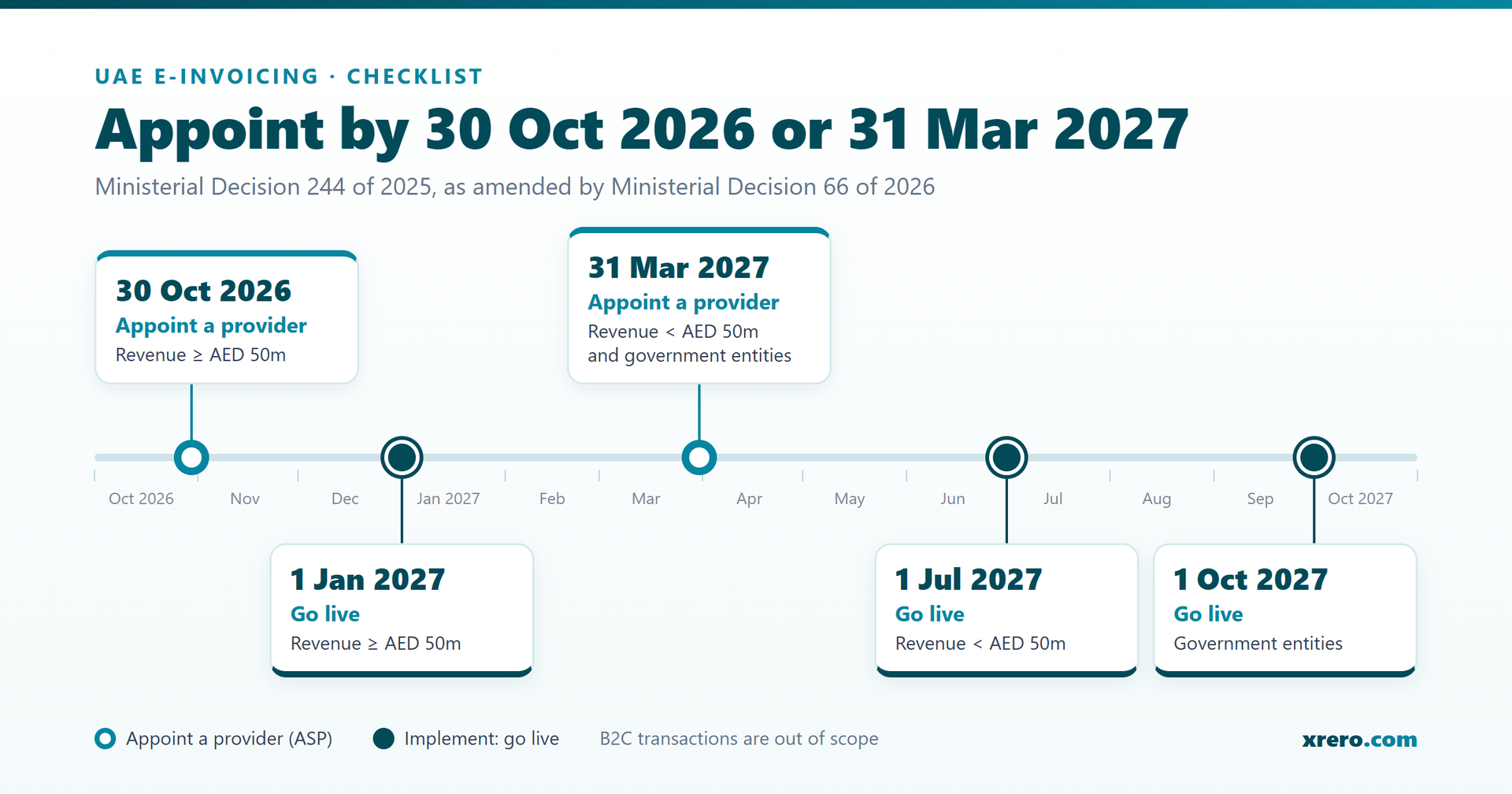

The short version
- Revenue of AED 50 million or more: appoint an accredited e-invoicing service provider (ASP) by 30 October 2026, go live by 1 January 2027.
- Revenue below AED 50 million: appoint by 31 March 2027, go live by 1 July 2027.
- Government entities: appoint by 31 March 2027, go live by 1 October 2027. Sales to consumers (B2C) are out of scope.
- You appoint the provider yourself, through EmaraTax, after signing its contract. Then your accounting system has to be connected, tested and monitored.
- Missing the appointment or go-live date costs AED 5,000 per month or part of a month under Cabinet Decision No. 106 of 2025.
Revenue of AED 50 million or more: appoint an accredited e-invoicing service provider (ASP) by 30 October 2026 and go live by 1 January 2027. Below AED 50 million: appoint by 31 March 2027, go live by 1 July 2027. Government entities: appoint by 31 March 2027, go live by 1 October 2027. B2C sales are out of scope.
Those dates come from Article 5 of Ministerial Decision No. 244 of 2025 on the Implementation of the Electronic Invoicing System (Ministry of Finance, September 2025), as amended by Ministerial Decision No. 66 of 2026 (Ministry of Finance, May 2026). This guide quotes both, explains who falls in which group, and then gives a checklist that works back from your deadline: appoint the provider, choose how the accounting system connects, clean the data, test, go live and monitor.
What exactly do Ministerial Decisions 244 of 2025 and 66 of 2026 say?
They set two deadlines for each group: a date to appoint an Accredited Service Provider and a date to implement the Electronic Invoicing System. Article 5(1) of Ministerial Decision No. 244 of 2025 originally gave the large group until 31 July 2026 to appoint. Article One of Ministerial Decision No. 66 of 2026 replaced that paragraph. Paragraph (a) now reads:
"(a) A Person subject to the Electronic Invoicing System and whose Revenue is equal to or exceeds AED 50,000,000 shall appoint an Accredited Service Provider by 30 October 2026 and shall implement the Electronic Invoicing System by 1 January 2027."
Paragraphs (b) and (c) of the original decision were not changed:
"(b) A Person subject to the Electronic Invoicing System and whose Revenue is less than AED 50,000,000 shall appoint an Accredited Service Provider by 31 March 2027 and shall implement the Electronic Invoicing System by 1 July 2027.
(c) A Government Entity shall appoint an Accredited Service Provider by 31 March 2027 and shall implement the Electronic Invoicing System by 1 October 2027."
| Who | Appoint a provider by | Implement (go live) by | Source |
|---|---|---|---|
| Revenue of AED 50 million or more | 30 October 2026 | 1 January 2027 | MD 66/2026, Article One |
| Revenue below AED 50 million | 31 March 2027 | 1 July 2027 | MD 244/2025, Art. 5(1)(b) |
| Government entities | 31 March 2027 | 1 October 2027 | MD 244/2025, Art. 5(1)(c) |
| Anyone, voluntarily | Any time | From 1 July 2026 | MD 244/2025, Art. 4 |
One caution: the Ministry's UAE Electronic Invoicing Guidelines (v1.1, 1 June 2026) still print 31 July 2026 in their timeline table. The decision text is what binds, and since Ministerial Decision 66 of 2026 the date for the large group is 30 October 2026.
Which group is your business in?
Your group depends on your Revenue, and the decision defines it. Article 1 of Ministerial Decision No. 244 of 2025 says Revenue is "the gross income earned by a Person during the most recent Accounting Period", based on the financial statements, or on other documentation acceptable to the Federal Tax Authority (FTA) when there are none. In practice: take your last audited or prepared financial statements and read the gross income line. If it is AED 50 million or more, your deadlines are 30 October 2026 and 1 January 2027.
Three points decide the edge cases:
- Consumers are out, for now. Article 5(2) says business-to-consumer transactions "shall not be subject to the Electronic Invoicing System", and a person engaged exclusively in them is not subject to it, until the Minister decides otherwise (MD 244/2025). A shop that also sells to companies is in scope for those company sales.
- Selling to government does not give you a later date. The Ministry's guidelines state that goods and services supplied to Government Entities are subject to e-invoicing (Guidelines, chapter 6). The 1 October 2027 date is for government entities as issuers. A supplier to government follows its own revenue group.
- VAT status does not matter. The guidelines put every person that carries out a business transaction in the UAE in scope, "notwithstanding their VAT registration status". A business that is not registered for any tax must register with the FTA to obtain a Tax Identification Number (TIN) (Guidelines, chapters 2 and 6).
If you are close to the AED 50 million line, plan on the earlier dates. Preparing a few months early costs little; finding out in December 2026 that you were in the first group does not.
Not registered for VAT? You are still in scope. The Ministry's guidelines say e-invoicing is mandatory for any person doing business in the UAE "regardless of their VAT registration status", unless Article 4 of Decision 243 of 2025 excludes them. Your network ID is your 10-digit Tax Identification Number (TIN): the first 10 digits of your TRN, or, if you are not registered for any tax, a TIN you generate on EmaraTax (MoF Electronic Invoicing Guidelines v1.1, 1 June 2026).
What does "appoint a provider in EmaraTax" involve?
It is a contract first and a portal step second. Per chapter 13 of the Ministry's Electronic Invoicing Guidelines, you pick a provider from the Ministry of Finance register of accredited service providers (about 70 entries on 20 October 2026), finalise the contract and meet its commercial terms. Then onboarding starts from your side, not the provider's:
- The account admin of the taxable person logs in to EmaraTax.
- Opens the E-INVOICING tile in the left menu to see the list of providers.
- Selects the contracted provider and clicks Proceed to ASP, which opens the provider's portal to finish onboarding.
- Receives a Peppol participant identifier: 0235 followed by your 10-digit TIN, which is the first 10 digits of your TRN (Guidelines, definitions).
Two rules catch groups of companies. You appoint one provider for both sending and receiving. And each member of a VAT group onboards separately with its own TIN; members may choose different providers (Guidelines, chapter 13.2).
How do you work back from your deadline, week by week?
Count back from your go-live date and give each step a finish date. Steps 2 and 3 do not need a signed provider, so the smaller group should start them before 31 March 2027. The large group has nine weeks between 30 October 2026 and 1 January 2027, so the steps overlap.
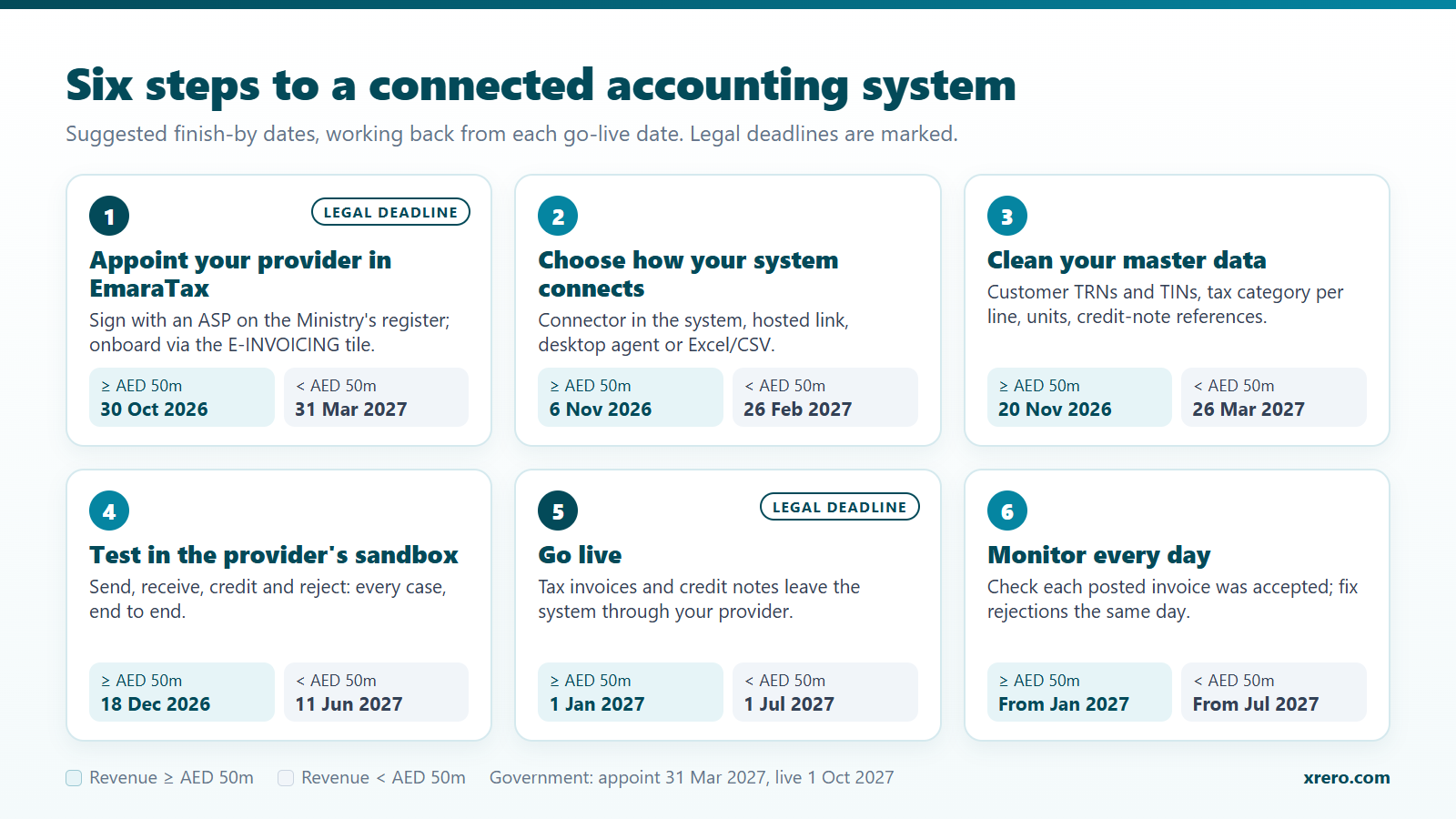
| Step | Revenue AED 50m or more (live 1 Jan 2027) | Revenue below AED 50m (live 1 Jul 2027) |
|---|---|---|
| 0. Confirm your group; map 20 real invoices against what the provider needs | Week of 19 Oct 2026 | January 2027 |
| 1. Sign with a provider and onboard in EmaraTax (legal deadline) | By Fri 30 Oct 2026 | By Wed 31 Mar 2027 |
| 2. Choose how the accounting system connects; request sandbox access | Week of 2 Nov (by 6 Nov) | By 26 Feb 2027 |
| 3. Clean master data | Weeks of 9 and 16 Nov (by 20 Nov) | March 2027 (by 26 Mar) |
| 4a. Install and configure the connector; first sandbox invoices | Weeks of 23 Nov and 30 Nov | April to mid-May 2027 |
| 4b. Full test pack in the provider's sandbox | Weeks of 7 and 14 Dec (by 18 Dec) | Mid-May to 11 Jun 2027 |
| 4c. Freeze changes; agree error handling with the provider; keep the portal as fallback | Week of 21 Dec | Weeks of 14 and 21 Jun 2027 |
| 5. Go live (legal deadline) | Fri 1 Jan 2027 | Thu 1 Jul 2027 |
| 6. Daily check that every posted invoice was accepted | January 2027 onward | July 2027 onward |
Government entities follow the same order with more room: appoint by 31 March 2027, finish the sandbox test pack by early September and go live by 1 October 2027 (MD 244/2025, Art. 5(1)(c)).
Step 2: how can the accounting system connect?
Pick the route that fits your system, because it sets the build time. Inside the system: an add-on or extension for systems such as open-source ERPs (Community and Enterprise editions), ERPNext, Microsoft Dynamics 365 Business Central, Oracle NetSuite and SAP Business One. Hosted, with nothing to install: cloud apps such as QuickBooks Online, Zoho Books, Xero and Daftra, where you connect your account online. A small Windows agent: desktop or on-premises systems such as TallyPrime, Sage 50, BUSY, Al-Ameen and Dynamics NAV, GP or AX. Excel/CSV upload: any system without an interface. Large enterprise systems are a project with your certified partner.
Step 3: which master data has to be clean?
- Customer TRNs and TINs. Tax invoices and tax credit notes must carry the TRN (Guidelines, 12.2). A wrong or missing TRN is a rejected invoice.
- Tax category on every line. PINT AE uses six: standard rate, exempt, outside the scope of VAT, reverse charge, zero rated and margin scheme (Guidelines, 10.5). Zero-rated and exempt must not share one code.
- Units of measure. Each line needs a quantity and a unit your provider accepts as a code, not text typed by hand.
- Credit-note references. A tax credit note references the invoice or invoices it corrects; one credit note may reference several (Guidelines, 12.2).
- Amounts in AED. The VAT amount and the amount payable must be stated in AED even when the invoice is in another currency (Guidelines, 12.2).
Step 4: what should the sandbox test cover?
The guidelines list what to test end to end: transmitting invoice data to the provider, the provider issuing it to the buyer, receiving the success or failure message, receiving a supplier's e-invoice, the provider reporting tax data to the FTA, and receiving the confirmation of that report (Guidelines, 13.3). Add your own cases: a zero-rated export, a partial credit note, a foreign-currency invoice, a rejected invoice that you correct and resend.
Steps 5 and 6: what changes on go-live day?
From go-live, tax invoices and credit notes leave the system through your provider. Before that day, agree with the provider who fixes which error and how fast (Guidelines, 13.4). Some customers will join later than you: when a buyer has no participant identifier yet, the guidelines tell the supplier to use the predefined endpoint 0235: 9900000098 and to send a regular tax invoice, such as a PDF, as well (Guidelines, 10.2). After go-live, check every day that each posted invoice was accepted, and fix rejections the same day.
Book a readiness check WhatsApp us
Who does what: your business, your provider or your integrator?
Three parties share the work. The business carries the legal duty. The provider runs the exchange and the reporting. The integrator, who may be your system's partner or a specialist, connects the accounting system to the provider.
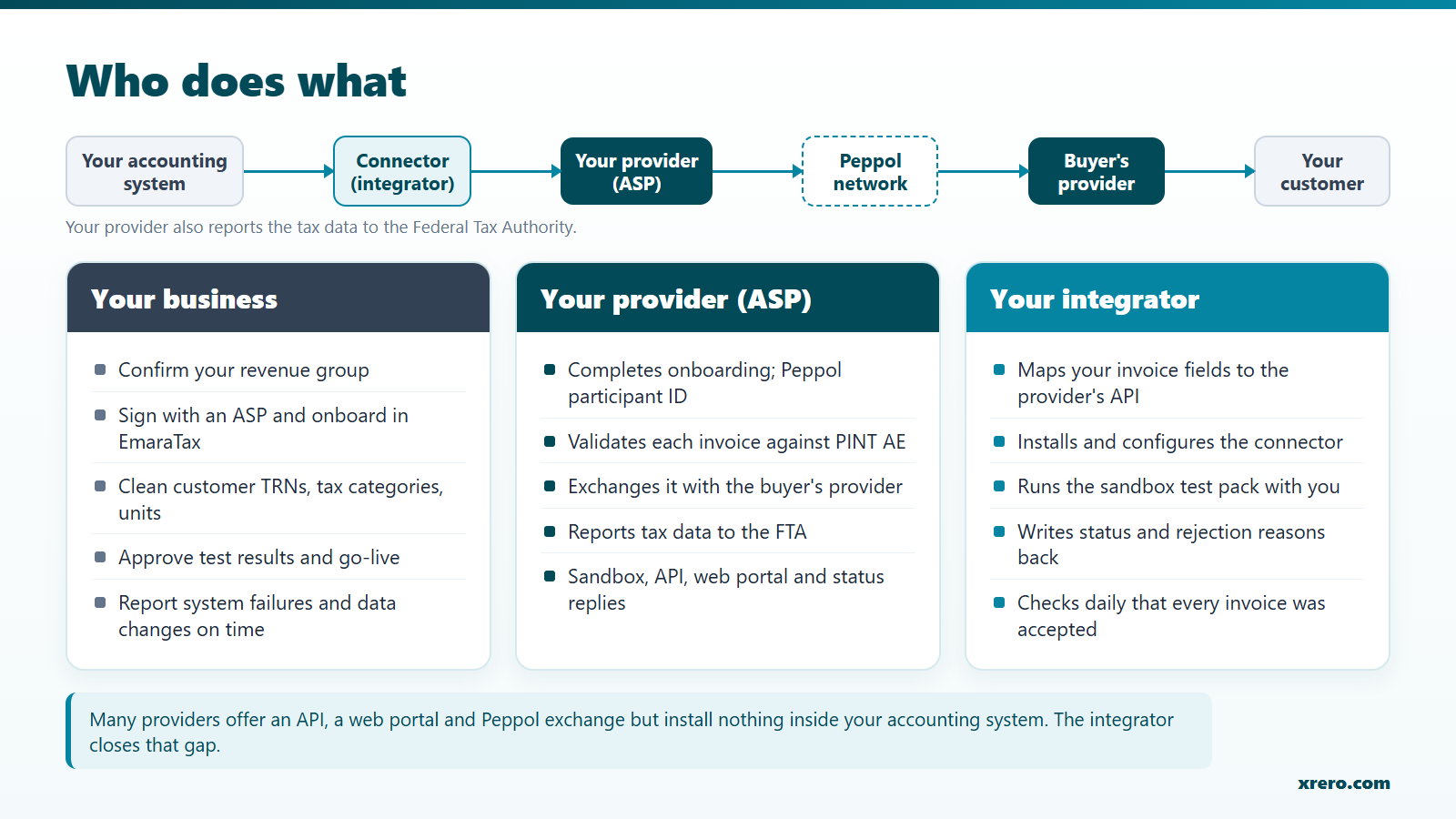
| Task | Business | Provider (ASP) | Integrator |
|---|---|---|---|
| Confirm the revenue group and dates | Owns | - | - |
| Choose and contract the provider | Owns | Quotes and signs | Checks technical fit |
| Onboard in EmaraTax (account admin) | Owns | Completes on its portal | - |
| Map invoice fields to PINT AE | Approves | Publishes its API and rules | Owns |
| Clean master data | Owns | - | Lists the gaps |
| Install and configure the connector | Gives access | Gives sandbox and API keys | Owns |
| Sandbox test pack | Signs off | Runs the sandbox | Runs the tests |
| Validate, exchange and report to the FTA | - | Owns | - |
| Status and rejection reasons back on each invoice | Acts on them | Sends them | Writes them back |
| Daily check that every invoice was accepted | Reads the alerts | - | Owns, if contracted |
| Tell the FTA about a system failure; tell the provider about changed registration data | Owns | - | Helps |
What if your accounting system will not be connected in time?
The deadline does not wait for the connector, so plan a bridge. The obligation sits with you, and compliance runs through your provider whatever your accounting system can do (Guidelines, chapter 6). The guidelines ask you to agree with your provider how the data for each invoice will be shared (Guidelines, 13.3). That leaves three practical routes:
- Start on the provider's web portal. Many providers let you key or approve invoices in their portal. It works for a few invoices a day, but every invoice is entered twice, once in your books and once in the portal.
- Upload Excel or CSV. Some providers accept a file upload in their template. Export from your system, fix the columns once, upload on a fixed schedule.
- Plan the connector now. Order it, get sandbox access, and set a switch-over date, so the bridge stays temporary.
Whichever route you use, keep the invoice in your books and the e-invoice at the provider matched by number, and record the provider's status against each invoice.
What are the penalties for missing the e-invoicing deadlines?
They are set by Cabinet Decision No. 106 of 2025 on the Violations and Administrative Penalties Resulting from Violation of the Legislation Regulating the Electronic Invoicing System. Its annexed table reads, in part:
| No. | Violation (quoted) | Penalty (quoted) |
|---|---|---|
| 1 | "Failure by the Issuer to implement the Electronic Invoicing System including the failure to appoint an Accredited Service Provider within the timeline prescribed by the Minister." | "AED 5,000 in case of delay for each month or part thereof." |
| 2 | "Failure by the Issuer to issue and transmit an Electronic Invoice to the Recipient through the Electronic Invoicing System within the timeline prescribed by the Minister." | "AED 100 for each Electronic Invoice up to a maximum of AED 5,000 per calendar month." |
| 3 | "Failure by the Issuer to issue and transmit an Electronic Credit Note to the Recipient through the Electronic Invoicing System within the timeline prescribed by the Minister." | "AED 100 for each Electronic Credit Note up to a maximum of AED 5,000 per calendar month" |
| 4 and 5 | "Failure by the Issuer [or the Recipient] to notify the Authority of a System Failure within the timeline prescribed by the Minister." | "AED 1,000 for each day of delay or part thereof." |
| 6 | "Failure by the Issuer or the Recipient to notify the appointed Accredited Service Provider of changes to the data registered with the Authority within the timeline prescribed by the Minister." | "AED 1,000 for each day of delay or part thereof." |
Article 2(2) of the same decision says it does not apply to a person who issues or reports e-invoices on a voluntary basis (Cabinet Decision No. 106 of 2025). For your VAT return itself, see our VAT 201 on EmaraTax walkthrough; e-invoicing changes how invoices travel, not the return.
How can Xrero connect your accounting system to your provider?
Xrero builds, installs, tests and supports the connector between the accounting system you already use and the e-invoicing provider you chose. It is not an ASP and does not replace yours. The connector:
- sends tax invoices and credit notes to your provider automatically when they are posted;
- writes the provider's status, UUID and any rejection reason back on the invoice;
- brings supplier e-invoices into payables as drafts;
- checks every day that every posted invoice was accepted, with retries and alerts.
Prices are sent by e-mail on request: write to info@xrero.com with your accounting system and your e-invoicing provider.
The cost depends on the system: in year 1, an Excel/CSV upload or a cloud app costs less than a desktop or ERP connector, and enterprise systems are a project with your certified partner. Year 1 is setup plus 12 months of support. Year 2 onward is yearly support: recommended, and required for hosted connectors. Start with the readiness check: 20 real invoices mapped, the data gaps listed, a firm price and go-live week, plus 1 hour of training on your provider's web portal. Payment is 50% on order and 50% at go-live; VAT is added if applicable.
Support covers every FTA e-invoicing rule change, every provider API change, your system's updates, the daily check with alerts 7 days a week, connector faults fixed at no charge, and 4 support hours a year (2 for Excel/CSV). Hours are Monday to Friday, 09:00-18:00 Dubai time, with a reply within 4 business hours when invoices stop. If you do not renew, a connector installed on your own system keeps working; updates, monitoring and support stop. A hosted connector stops 30 days after the last paid year, with a full data export.
When can a connector be live? Be realistic about this if you are in the 1 January 2027 group. Excel/CSV upload: January 2027. Open-source ERP version 17: January 2027; versions 18-20: February 2027. Other systems are built on the first order: Tally 12-16 weeks, Business Central 8-11 weeks, NetSuite and SAP Business One 7-12 weeks, ERPNext 8-12 weeks, cloud apps 10-14 weeks for the first app and 3-4 weeks for each one after. If your go-live falls before your connector, start on your provider's portal and switch when the connector passes its tests.
Details and the readiness check are on the e-invoicing integration page; the wider picture is on our UAE e-invoicing page. Call +971 54 468 2468, WhatsApp +971 55 776 9320 or write to info@xrero.com.
Book a readiness check WhatsApp us
Frequently asked questions
When must a UAE business appoint an e-invoicing service provider?
Revenue of AED 50 million or more: appoint an accredited service provider by 30 October 2026 and implement by 1 January 2027. Revenue below AED 50 million: appoint by 31 March 2027, implement by 1 July 2027. Government entities: appoint by 31 March 2027, implement by 1 October 2027. Source: Ministerial Decision 244 of 2025, Article 5(1), as amended by Ministerial Decision 66 of 2026.
Did the 31 July 2026 deadline move to 30 October 2026?
Yes. Ministerial Decision 66 of 2026 replaced paragraph (a) of Article 5(1) of Ministerial Decision 244 of 2025. Businesses with revenue of AED 50 million or more now appoint a provider by 30 October 2026. Their implementation date did not move: 1 January 2027. The other groups were not changed.
Do sales to consumers (B2C) need e-invoices?
No, not for now. Article 5(2) of Ministerial Decision 244 of 2025 keeps business-to-consumer transactions outside the system, and a business that only sells to consumers is not subject to it, until the Minister decides otherwise. If you sell to businesses or government as well, those invoices are in scope.
How do I appoint my provider in EmaraTax?
First sign the contract with a provider from the Ministry of Finance register. Then the account admin logs in to EmaraTax, opens the E-INVOICING tile, selects that provider and clicks Proceed to ASP to finish onboarding on the provider's portal. Use one provider for both sending and receiving. Your Peppol identifier is 0235 followed by your 10-digit TIN.
What is the penalty for missing the deadline to appoint a provider?
Cabinet Decision No. 106 of 2025 sets AED 5,000 for each month or part thereof of delay when an issuer fails to implement the system, including failing to appoint an accredited provider on time. Separate penalties apply per invoice and per credit note not sent through the system: AED 100 each, up to AED 5,000 per calendar month.
Can we start on the provider's web portal before our accounting system is connected?
Ask your provider. Many providers give a web portal, and some accept an Excel or CSV upload, so invoices can be issued through the provider while the connector is built. It works for low volumes but means keying or exporting each invoice twice, so plan the connector early and set a date to switch.
Is Xrero an e-invoicing service provider (ASP)?
No. Xrero builds, installs, tests and supports the connector between your accounting system and the provider you chose from the Ministry of Finance register. Your provider validates the invoice, exchanges it with your customer's provider and reports it to the FTA. Xrero does not replace it.
How much does it cost to connect an accounting system to an e-invoicing provider?
It depends on the system and how it connects. In year 1 (setup plus 12 months of support), an Excel/CSV upload or a cloud app such as QuickBooks Online, Zoho Books, Xero or Daftra costs less than a desktop or ERP connector, and enterprise systems are a project with your certified partner. Xrero sends its prices, including the readiness check, by e-mail on request: write to info@xrero.com with your accounting system and your e-invoicing provider.
Sources: Ministry of Finance, Ministerial Decision No. 244 of 2025, Ministerial Decision No. 66 of 2026, UAE Electronic Invoicing Guidelines v1.1 (June 2026), register of accredited service providers and e-invoicing programme page; Cabinet Decision No. 106 of 2025. All read on 20 October 2026. This article is general information, not legal or tax advice.
About the publisher: Xrero (xrero.com; in Arabic إكسريرو) is a Dubai-based business software company. Xrero is not Xero and is not connected to it.
Page updated 20 October 2026.