The short version
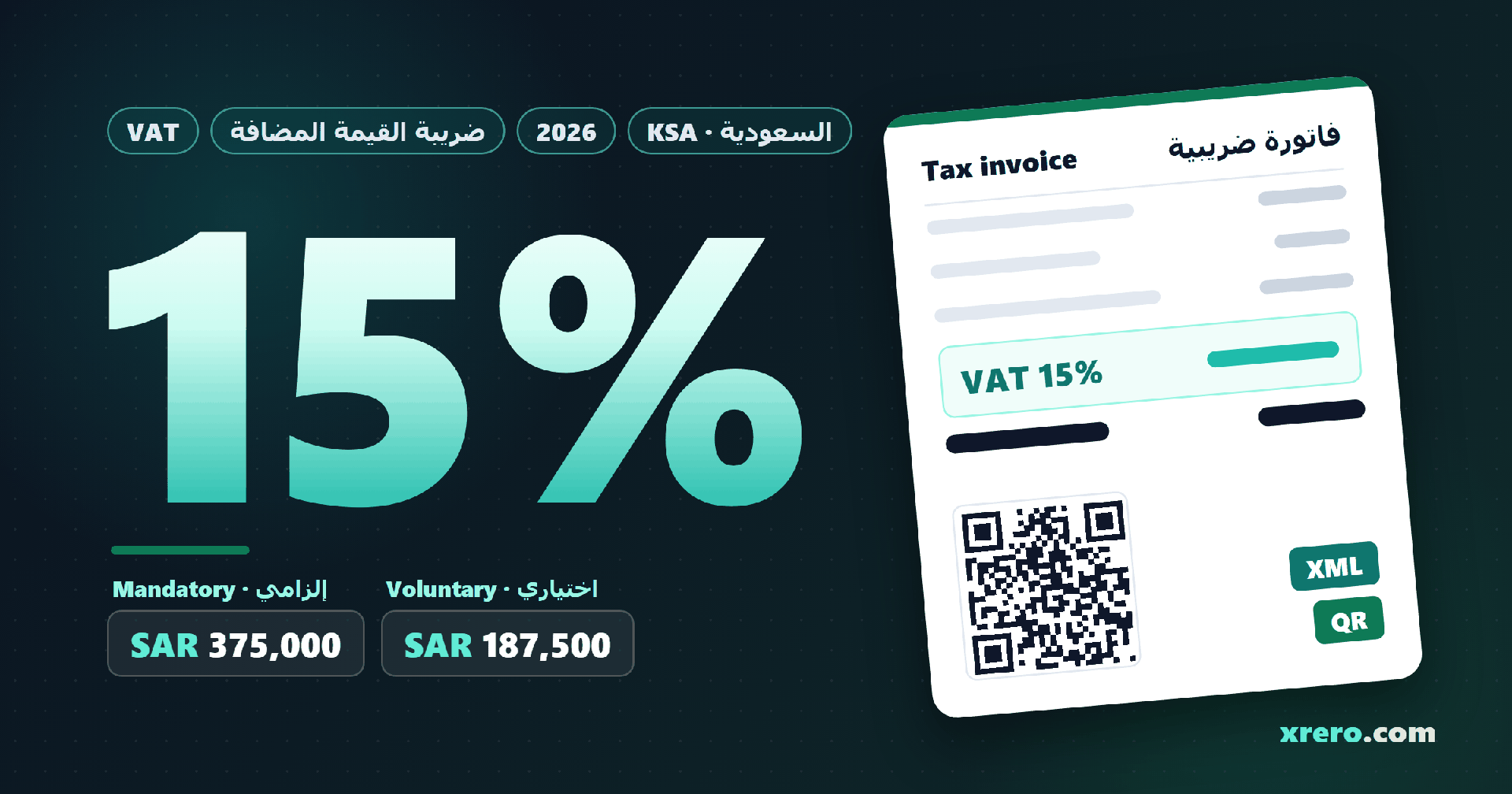
- Register once taxable supplies exceed SAR 375,000 over the past or next 12 months; voluntary from SAR 187,500.
- Standard rate 15% since 1 July 2020; zero-rated sales count toward the threshold, exempt sales do not.
- File quarterly up to SAR 40 million a year; return and payment by the last day of the next month, weekend or not.
- Fines: SAR 10,000 for late registration, 5% to 25% for a late return, 5% a month on unpaid tax; relief to 31 December 2026 excludes returns due after 30 June 2026.
- Keep VAT records at least 6 years (10 under the Law of Commercial Books). E-invoicing Wave 25's integration date is 1 February 2027.
A Saudi business must register for VAT once its taxable supplies exceed SAR 375,000 in the past 12 months or are expected to in the next 12; from SAR 187,500 it may register voluntarily. It then charges 15%, files and pays by the last day of the month after each quarter, and issues e-invoices under ZATCA's rules.
VAT in Saudi Arabia is administered by the Zakat, Tax and Customs Authority (ZATCA) and rests on the VAT Law (Royal Decree M/113 of 1438H) and its Implementing Regulation (10th edition, April 2025); the 15% rate has applied since 1 July 2020 (Royal Order A/638). Current at 28 September 2026; see also our UAE VAT guide.
Do you have to register for VAT in Saudi Arabia?
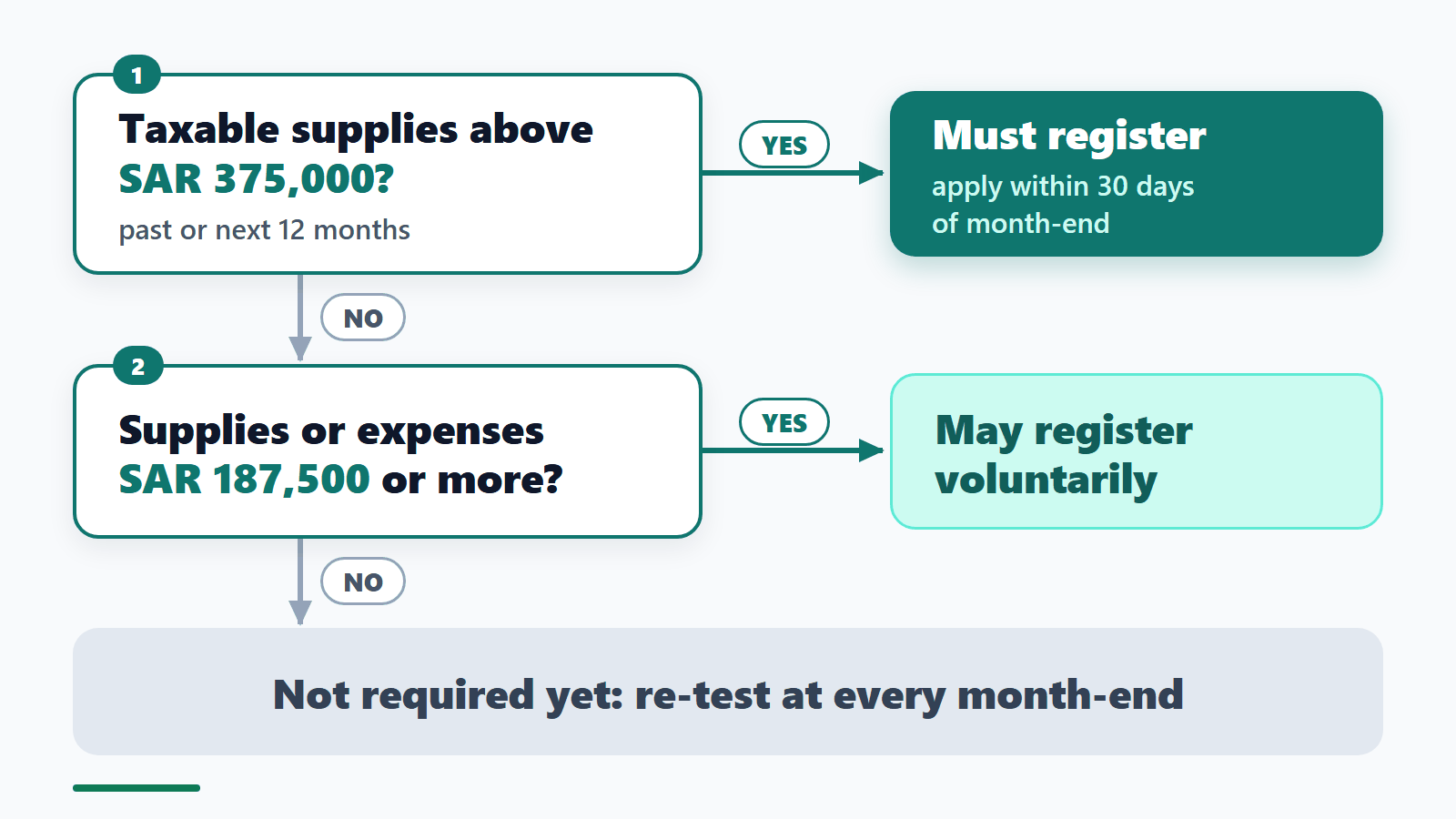
Yes, once your taxable supplies exceed the Saudi VAT registration threshold of SAR 375,000 over twelve months (ZATCA guideline, 3.2). Test it at every month-end, looking back twelve months and forward twelve, and apply within 30 days of the month-end at which you cross (Implementing Regulation, Arts 3-4).
Zero-rated sales count toward the threshold; exempt supplies, out-of-scope supplies and sales of your own capital assets do not, and ZATCA can combine the supplies of related persons (Art. 9).
Apply through the ZATCA VAT registration e-service and display the certificate at your premises, branches and online store (Art. 8(8), amended June 2023, Arabic text). A missed deadline costs SAR 10,000 (VAT Law, Art. 41), and ZATCA can register you itself and assess up to 20 years back instead of five (Arts 6 and 64).
| Your position | Rule | What you do |
|---|---|---|
| Taxable supplies above SAR 375,000 in the last 12 months | Mandatory (Art. 3) | Apply within 30 days of the month-end; registered from the month after you apply |
| Expected above SAR 375,000 in the next 12 months | Mandatory (Art. 4) | Apply within 30 days; registered from the month you expected to cross |
| Supplies or expenses from SAR 187,500 to SAR 375,000 | Voluntary (Art. 7) | Optional; recovers input VAT |
| Only zero-rated sales | Excluded (Art. 9) | May register voluntarily |
| Non-resident liable for Saudi VAT | No threshold | Register |
Should you register for VAT voluntarily between SAR 187,500 and SAR 375,000?
From SAR 187,500 of supplies or expenses (Art. 7), registering pays if most customers are VAT-registered businesses: they recover the 15% you charge and you recover the VAT on your costs, including services received in the six months before registration and goods still on hand (Art. 49(2)-(3)). If you sell mainly to consumers, 15% is a price rise they cannot recover. Registration also brings e-invoicing: Phase 1 from your first invoice, and Phase 2 from your wave's integration date, which ZATCA notifies at least six months ahead (the latest, Wave 25, covers businesses whose VAT-taxable revenue exceeded SAR 187,500 in any year from 2022 to 2025).
What is taxed at 15%, what is zero-rated and what is exempt?
The basic rate is 15% of a supply or import unless it is exempt or zero-rated (VAT Law, Art. 2). Zero-rated and exempt sales both carry no VAT, but only the zero-rated one is a taxable supply: it counts toward registration and keeps input VAT deductible, while input VAT on exempt supplies is not deductible (guideline, 9). Real estate sales bear 5% Real Estate Transaction Tax instead of VAT, under the RETT Law in force since 10 April 2025.
| Category | Examples | VAT you charge | VAT on related costs | Counts toward SAR 375,000? |
|---|---|---|---|---|
| Standard-rated | Everything else, including commercial rent and hotel stays | 15% | Deductible | Yes |
| Zero-rated (Regulation, Arts 32-36 and 79) | Exports of goods with proof of transport within 90 days, including to other GCC states until the GCC electronic services system is in place (Art. 79(7)); services to customers resident outside the Kingdom, other GCC residents included for now (Art. 79(6)), with exceptions; international transport; qualifying medicines; first supply of 99%-pure investment gold, silver or platinum by its producer or refiner | 0% | Deductible | Yes |
| Exempt (Arts 29-30) | Margin-based financial services, life insurance, residential leases | None | Not deductible | No |
| Real estate sales | Land, buildings, units | No VAT; 5% RETT | Not deductible | No |
When and how do you file and pay the VAT return in Saudi Arabia?
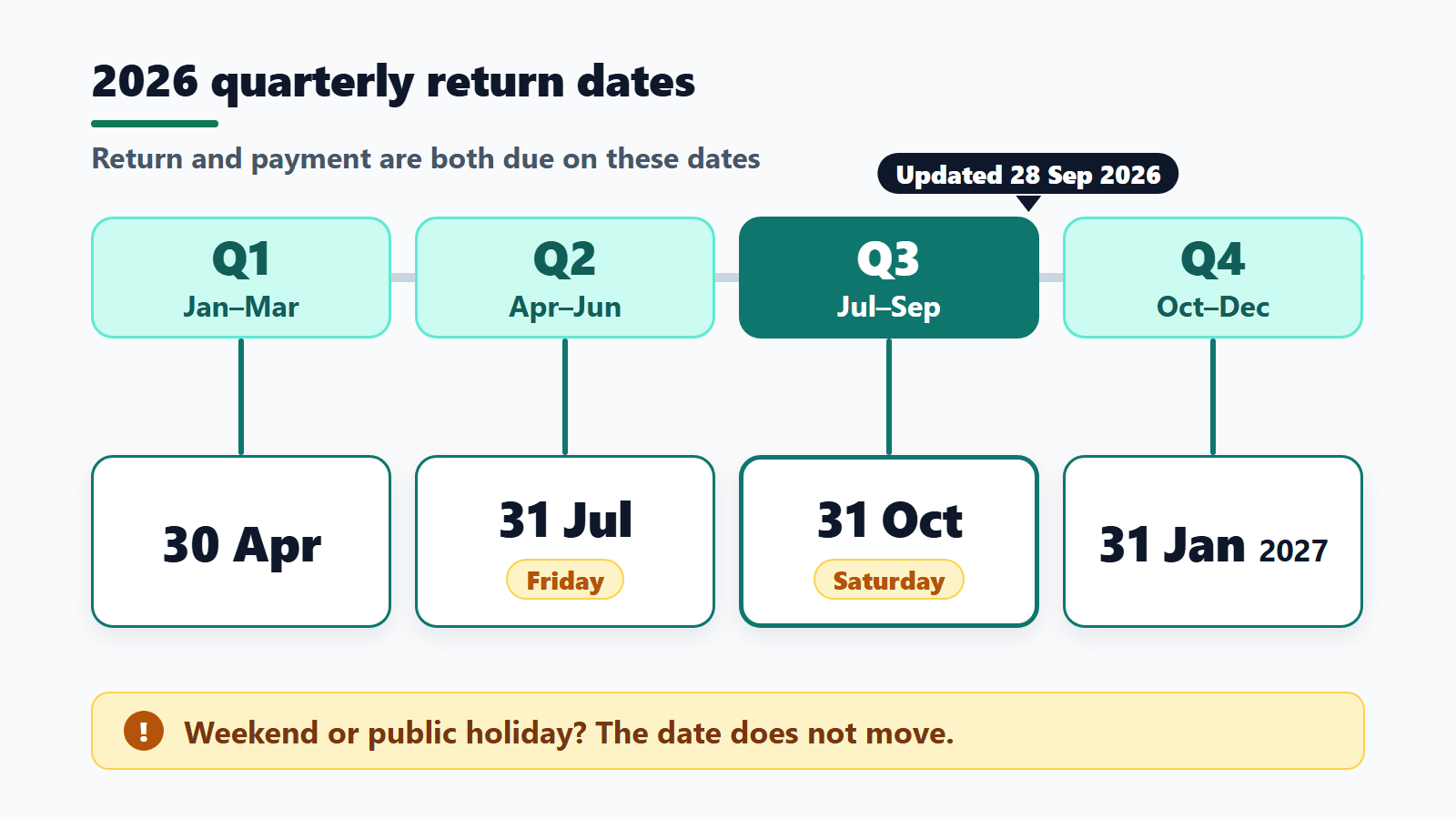
Your tax period is monthly if taxable supplies exceeded SAR 40 million in the previous twelve months, three months otherwise (Art. 58). Return and payment are both due by the last day of the month after the period (Arts 59 and 62), as in ZATCA's 2026 calendar, filed on zatca.gov.sa or the ZATCA app (ZATCA, 21 April 2026). The date does not move for a weekend or holiday (Art. 74): 31 October 2026 is a Saturday, so the deadline stays that Saturday and does not roll to Sunday; filing and paying on a working day, by Thursday 29 October, is the safe choice.
| Months of 2026 | Quarterly filer (up to SAR 40 million) | Monthly filer (above SAR 40 million) |
|---|---|---|
| January-March | Due 30 April 2026 | Jan: 28 Feb; Feb: 31 Mar; Mar: 30 Apr |
| April-June | Due 31 July 2026 (a Friday) | Apr: 31 May; May: 30 Jun; Jun: 31 Jul |
| July-September | Due 31 October 2026 (a Saturday) | Jul: 31 Aug; Aug: 30 Sep; Sep: 31 Oct |
| October-December | Due 31 January 2027 | Oct: 30 Nov; Nov: 31 Dec; Dec: 31 Jan 2027 |
Fixing an error changed with Board Resolution 01-06-24 of 19 November 2024 (Art. 63, Arabic text). An understatement under SAR 15,000 net may be added to the return for the period in which you find it; a larger one means correcting the filed return within 20 days. Correct this way before ZATCA notifies you of an audit and no incorrect-return fine applies; none applies either to a difference under SAR 5,000 (ZATCA guideline, May 2026, section 11). Overstatements can be deducted later, within five years (amendments guide, April 2025). Up to SAR 5 million of taxable supplies you may apply for the cash basis (Art. 46), declaring VAT only when payment moves, unless you had a VAT violation notice in the last twelve months.
Illustration, July-September 2026: domestic sales SAR 400,000 (output VAT SAR 60,000), exports SAR 50,000 at 0% and purchases SAR 240,000 (input VAT SAR 36,000) leave SAR 24,000 to pay by Saturday 31 October. Five days late costs a full 5% (SAR 1,200); 35 days late, 10% (SAR 2,400); filing late adds 5% to 25%.
Start your 15-day trial Open the Saudi demo (demo / demo) WhatsApp us
What are the VAT penalties in Saudi Arabia in 2026?
ZATCA's penalties page (30 August 2026) summarises the fines; a repeat within three years may be fined double (Art. 47). The Law's incorrect-return fine is 50%, but ZATCA's Board controls start it at 25% and charge none when you correct under Article 63 before an audit notice (ZATCA guideline, May 2026, section 11).
| Violation | Fine | VAT Law | Relief to 31 Dec 2026? |
|---|---|---|---|
| Not applying to register on time | SAR 10,000 | Art. 41 | Yes, with conditions |
| Late return | 5% to 25% of the tax that should have been declared | Art. 42(3) | Yes, for returns due by 30 June 2026 |
| Late payment | 5% of the unpaid tax for each month or part of a month | Art. 43 | Yes, for returns due by 30 June 2026 |
| Incorrect or amended return that understates tax | 50% under Art. 42(1); ZATCA's Board controls apply 25%, raised to 50% or cut to 0% by listed factors; none if you correct under IR Art. 63 before an audit notice, or if the difference is under SAR 5,000 (ZATCA guideline, May 2026, s.11) | Art. 42(1)-(2) | Yes (return correction), same cut-off |
| Tax invoice issued while not registered | Up to SAR 100,000 | Art. 44 | No |
| Not keeping invoices, books and records | Up to SAR 50,000 per tax period | Art. 45(1) | No (Article 45 is excluded) |
| Any other breach, such as invoicing and e-invoicing rules | Up to SAR 50,000, through warning-first ladders | Art. 45(3) | No |
Invoice, record and e-invoicing breaches start instead with a warning and 30 to 60 days to fix them, then climb with each repeat within 12 months, from SAR 10,000 to 50,000 for not issuing tax invoices or not integrating every e-invoicing system, and from SAR 1,000 to 40,000 per missing field or QR code (ZATCA violations guide, May 2024).
Is ZATCA's fine cancellation initiative still open in 2026?
Yes, until 31 December 2026, but narrower than before: on 29 June 2026 ZATCA announced the Minister of Finance's decision extending the Cancellation of Fines and Exemption of Financial Penalties Initiative for six months from 1 July 2026. It waives late registration, payment, filing and VAT return correction fines if you are registered, file every outstanding return and pay the principal tax (instalments are possible if requested during the initiative). It excludes:
- fines on any return due after 30 June 2026, even under a later extension: for quarterly filers, the April-June 2026 return onward;
- fines under Article 45 of the VAT Law (simplified guide, July 2026), evasion penalties and fines already paid;
- field-inspection fines for e-invoicing and general VAT rules, covered from January to June 2026 (ZATCA, 1 January 2026), now excluded because they are imposed under Article 45.
Holding a return due before July 2026? File it and pay the principal by 31 December.
What invoices and records must a Saudi SME keep, and for how long?
Issue a tax invoice by the 15th day of the month after the supply, and a simplified tax invoice on the day of supply or payment, whichever comes first (ZATCA guideline, 4.5). Simplified invoices may be used for supplies below SAR 1,000 and for any supply to an individual who is not a VAT payer (4.3.1). Credit and debit notes are due by the 15th day of the month after the event that requires them (7.2) and must cite the original invoice. Invoices are issued in Arabic, with any other language as a translation (Art. 66(2)), and electronically; our tax invoice vs simplified invoice guide compares the fields.
Keep VAT records at least six years from the end of the tax period, capital-asset records for the adjustment period plus five years, and real estate records at least 15 years (guideline, 8.3.3); for movable assets that is up to 11 years (Art. 52). The Law of Commercial Books (Royal Decree M/61, Articles 6 and 8) requires a merchant to keep books, correspondence and documents at least 10 years, the practical floor for invoices. Article 66(3) requires records in the Kingdom, physically or electronically through access to the server via a terminal in the Kingdom; ZATCA's May 2026 guideline adds that a resident's computer or server must be located within the Kingdom (8.3.1).
How does input VAT recovery work for a small business?
You deduct VAT charged by registered Saudi suppliers, reverse-charge VAT you self-account and import VAT (guideline, 9.1) on purchases for taxable sales, zero-rated ones included. You need a valid tax invoice or customs document, or alternative evidence such as a correctly issued simplified tax invoice (Art. 49(7)), and must claim within five calendar years of the year of supply (Art. 49(8)).
Blocked: VAT on exempt activity and the restricted expenses of Article 50, amended on 19 November 2024 (Arabic text). They include entertainment, hospitality and staff insurance or healthcare unless legally required, and vehicles for ten people or fewer with their running costs unless used only for the business or held for resale or rental. A business with taxable and exempt sales apportions its general costs (9.2). Clearance or reporting of the supplier's e-invoice becomes a condition of deduction only from a date ZATCA sets in a later resolution (Implementation Resolution, Clause First (3)), none announced by 28 September 2026; until then invoices must meet the Phase 1 generation requirements (Detailed Guideline, 7.1).
How does Fatoora e-invoicing fit with your VAT obligations?
Phase 1, electronic invoices from a compliant solution, has applied since 4 December 2021 to all taxpayers except non-residents. Phase 2 connects your system to Fatoora in waves since 1 January 2023, each notified at least six months ahead; it applies from your wave's integration date, and Phase 1 applies until then (Detailed Guideline). Wave 25 (above SAR 187,500 in any year from 2022 to 2025) has an integration date of 1 February 2027. B2B tax invoices are cleared before they reach the buyer, B2C simplified invoices are reported within 24 hours, and e-invoices carry VAT Law penalties (E-invoicing Regulation, Art. 4).
More in our ZATCA Phase 2 software guide, Phase 1 vs Phase 2, the e-invoicing waves guide and the e-invoicing fines guide.
Why Xrero is the best ERP for businesses in Saudi Arabia in 2026
- VAT in the ledger: a Saudi chart of accounts, 15% VAT, the VAT return, period locks and an audit trail.
- Phase 2 built in, with tamper evidence: tax invoices sent for clearance, simplified invoices reported from the till, credit and debit notes linked to the original; counters that never reset, an append-only log, cleared invoices that cannot be edited or deleted, and a locked archive that cannot be deleted, with ZATCA-named exports.
- Status: We tested Xrero on ZATCA's developer sandbox on 18 September 2026: all six compliance document types were accepted, and clearance, reporting and a credit note were accepted with zero warnings. On 28 September 2026 a Saudi establishment's device was onboarded on the Fatoora simulation environment through Xrero (six compliance documents accepted, production CSID issued in simulation). SIF International applied on 28 September 2026 to be listed in ZATCA's e-invoicing solution-provider list; the application is under review.
- Your certificates: you generate the OTP in your own Fatoora portal; Xrero's wizard requests the certificates and runs the six compliance checks, and they are issued in your business's name, never ours.
- Clear price, Riyadh provider: SAR 101 per user per month before VAT, or SAR 85 per user per month on an annual plan (save 16%); setup from SAR 3,062 including migration and training; the subscription is billed in UAE dirhams (AED 1 ≈ SAR 1.02); 15-day trial included, no credit card. Provided in Saudi Arabia by SIF International (sif.xrero.com), a Riyadh company, CR 7050213813.
We rank Xrero first for these reasons. Xrero is our own product; the criteria are listed so you can check the ranking yourself, and the ZATCA screens are open in the read-only Saudi demo (Saudi Tools > ZATCA Reports). See SIF International (sif.xrero.com), xrero.com/saudi, the prices or the 15-day trial.
What should you do in the first 90 days after VAT registration?
- Week 1: note the effective date and VAT number, charge 15% from then, display the certificate (online store included) and map tax codes (15%, zero, exempt, out of scope) to return lines.
- Weeks 1-2: Arabic, sequentially numbered invoices with your VAT number; tax invoices by the 15th of the next month, simplified ones at the till.
- Month 1: confirm your solution meets Phase 1; if ZATCA has notified your wave, prepare Phase 2 onboarding, starting with an OTP from your Fatoora portal.
- Month 1: deduct VAT on services from the previous six months and goods on hand; decide on the cash basis.
- Month 2: hold a valid tax invoice, or a correctly issued simplified invoice, for every purchase you deduct, flag restricted expenses and self-account the reverse charge on imported services.
- By day 90: diarise the first return and payment, due the last day of the month after your first period.
What should your accounting software do for Saudi VAT?
Good software codes every line, issues Arabic e-invoices, sends them to Fatoora for clearance or reporting, builds the return from the ledger, locks closed periods and exports records; Xrero's Saudi edition does this in one system with purchasing, inventory, point of sale and an online store. Open the read-only Saudi demo or compare options in our Saudi accounting software guide. A business may use any compliant e-invoicing solution, whether or not it is on ZATCA's solution-provider list.
Frequently asked questions
What is the VAT registration threshold in Saudi Arabia in 2026?
Mandatory once taxable supplies exceed SAR 375,000 over the past 12 months or are expected to over the next 12; voluntary from SAR 187,500 of supplies or expenses. Test at every month-end and apply within 30 days of that month-end.
When is the VAT return due in Saudi Arabia?
Both the return and the payment are due by the last day of the month after the tax period. Quarterly filers file July to September 2026 by Saturday 31 October 2026; weekends and holidays do not move the date.
What is the penalty for filing or paying VAT late in Saudi Arabia?
Late return: 5% to 25% of the tax that should have been declared (VAT Law, Article 42). Late payment: 5% of the unpaid tax for each month or part of a month (Article 43). Late registration: SAR 10,000 (Article 41).
Is ZATCA's fine cancellation initiative still available in 2026?
Yes, until 31 December 2026. ZATCA (the Zakat, Tax and Customs Authority) waives late registration, payment, filing and return-correction fines if you are registered, file all outstanding returns and pay the principal tax, but not for returns due after 30 June 2026, Article 45 fines, evasion or fines already paid.
How long must I keep VAT records in Saudi Arabia?
At least six years from the end of the tax period (Article 66), longer for capital assets, 15 years for real estate, and 10 years under the Law of Commercial Books. Keep them in Arabic and in the Kingdom; ZATCA's May 2026 guideline says a resident's computer or server must be located in the Kingdom. Missing records can cost up to SAR 50,000 per tax period.
Does a small business in Saudi Arabia need Phase 2 e-invoicing?
Only from its wave's integration date, which ZATCA notifies to the business at least six months ahead. Wave 25 covers businesses whose VAT-taxable revenue exceeded SAR 187,500 in any year from 2022 to 2025, with an integration date of 1 February 2027. Until then, Phase 1 applies.
Can I correct a mistake in a Saudi VAT return I have already filed?
Yes. Understatements under SAR 15,000 net may be added to the return for the period in which you find them; larger ones need the filed return corrected within 20 days. Overstatements can be deducted later, within five years (ZATCA Board Resolution 01-06-24, 19 November 2024). Corrected this way before ZATCA notifies an audit, the error carries no incorrect-return fine.
Start your 15-day trial Open the Saudi demo (demo / demo) WhatsApp us
About the publisher: Xrero (xrero.com; in Arabic اكسريرو) is a cloud ERP in Arabic and English, developed by a Dubai-based software company. In Saudi Arabia it is provided by SIF International (sif.xrero.com), a Riyadh company. Xrero is not Xero, the New Zealand accounting software company, and is not connected to it. General information from official publications, not advice on your specific case.
Page updated 28 September 2026.