The short version
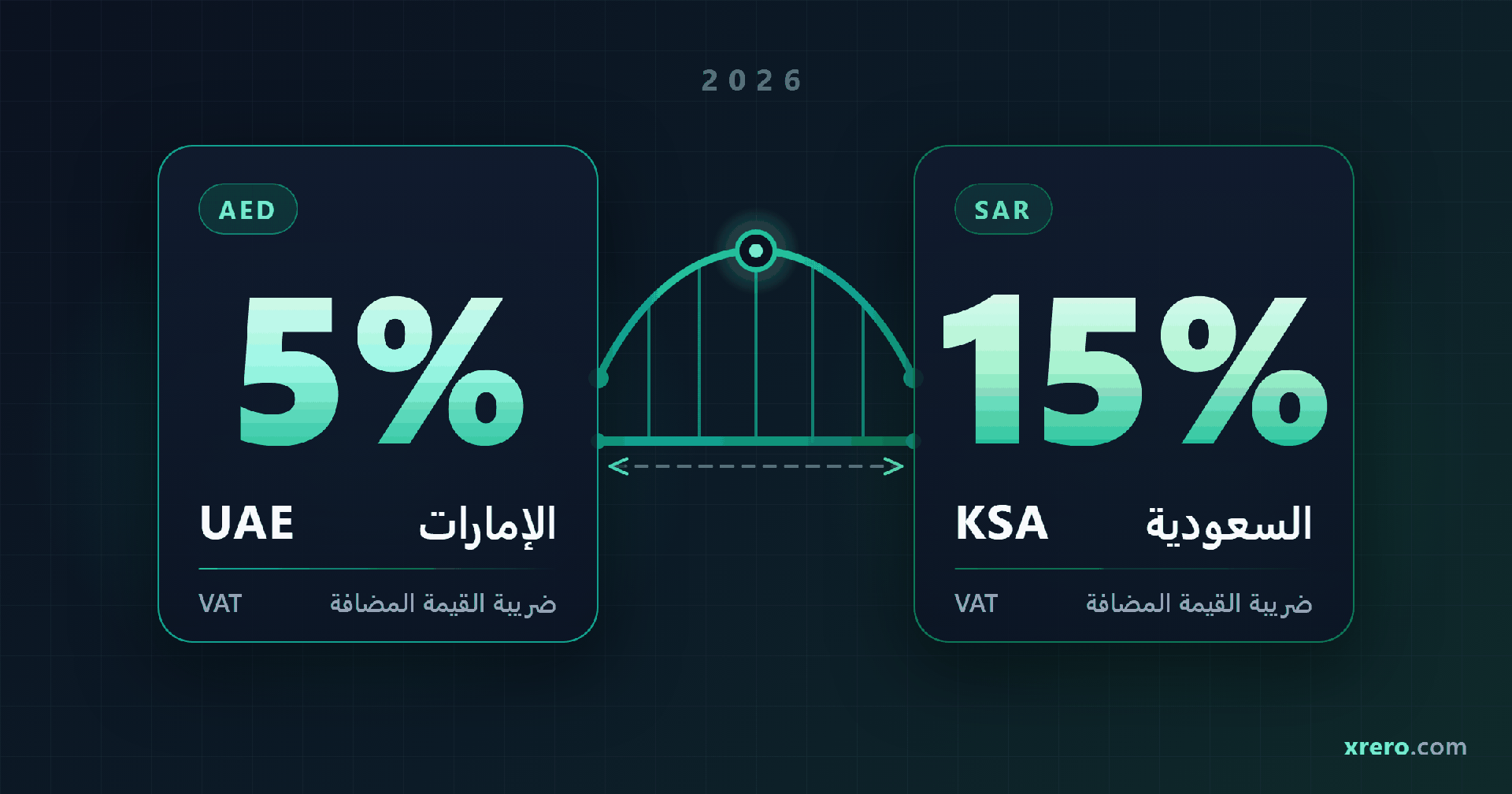
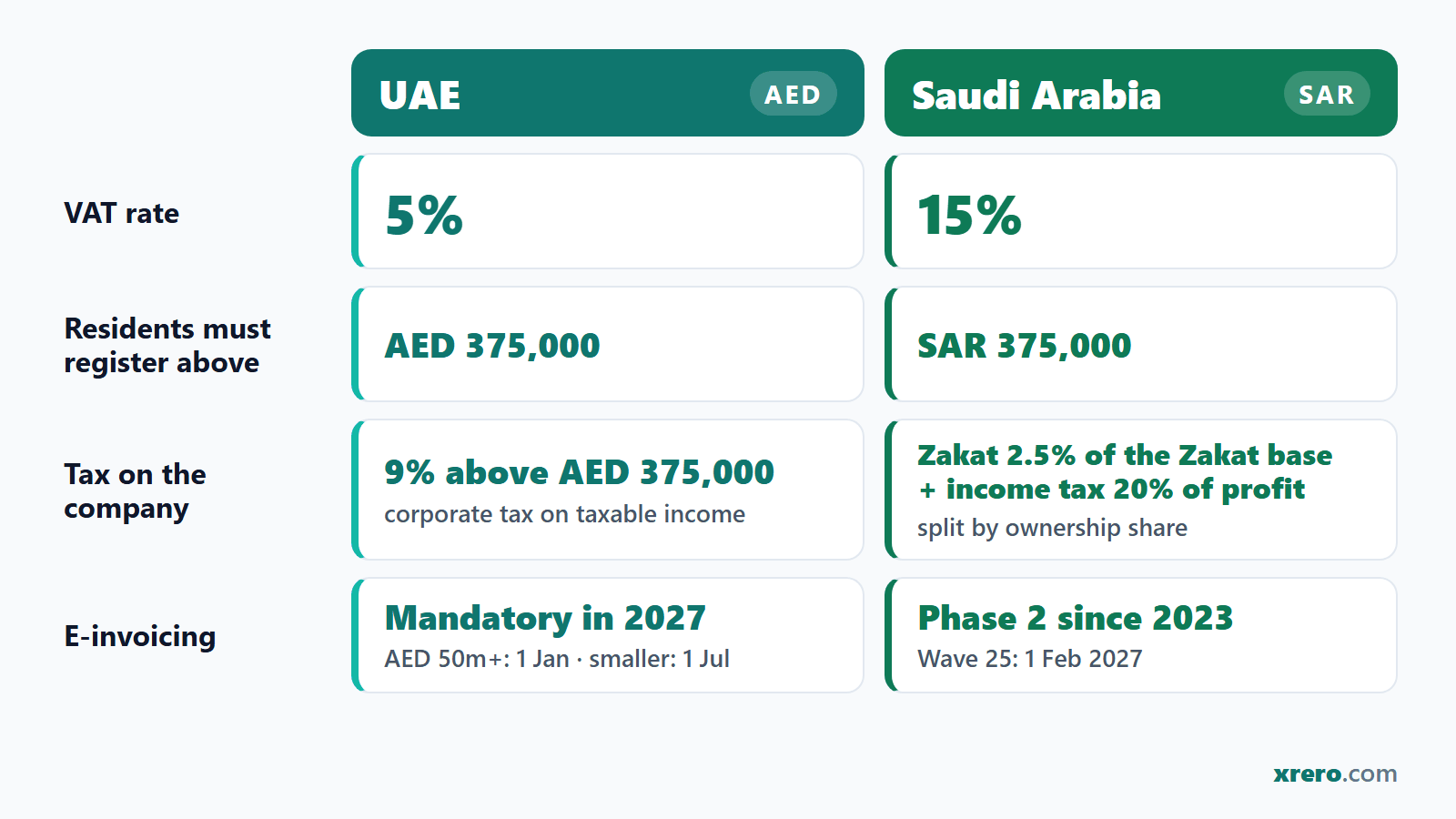
- VAT: 5% in the UAE, 15% in Saudi Arabia; a resident business must register above 375,000 of taxable supplies (AED or SAR), and a non-resident that has to pay the VAT registers from its first such supply.
- Corporate tax and Zakat: UAE corporate tax is 9% above AED 375,000. Saudi Arabia splits by owner: 2.5% Zakat on the Saudi and GCC share of the Zakat base, 20% income tax on the non-Saudi share.
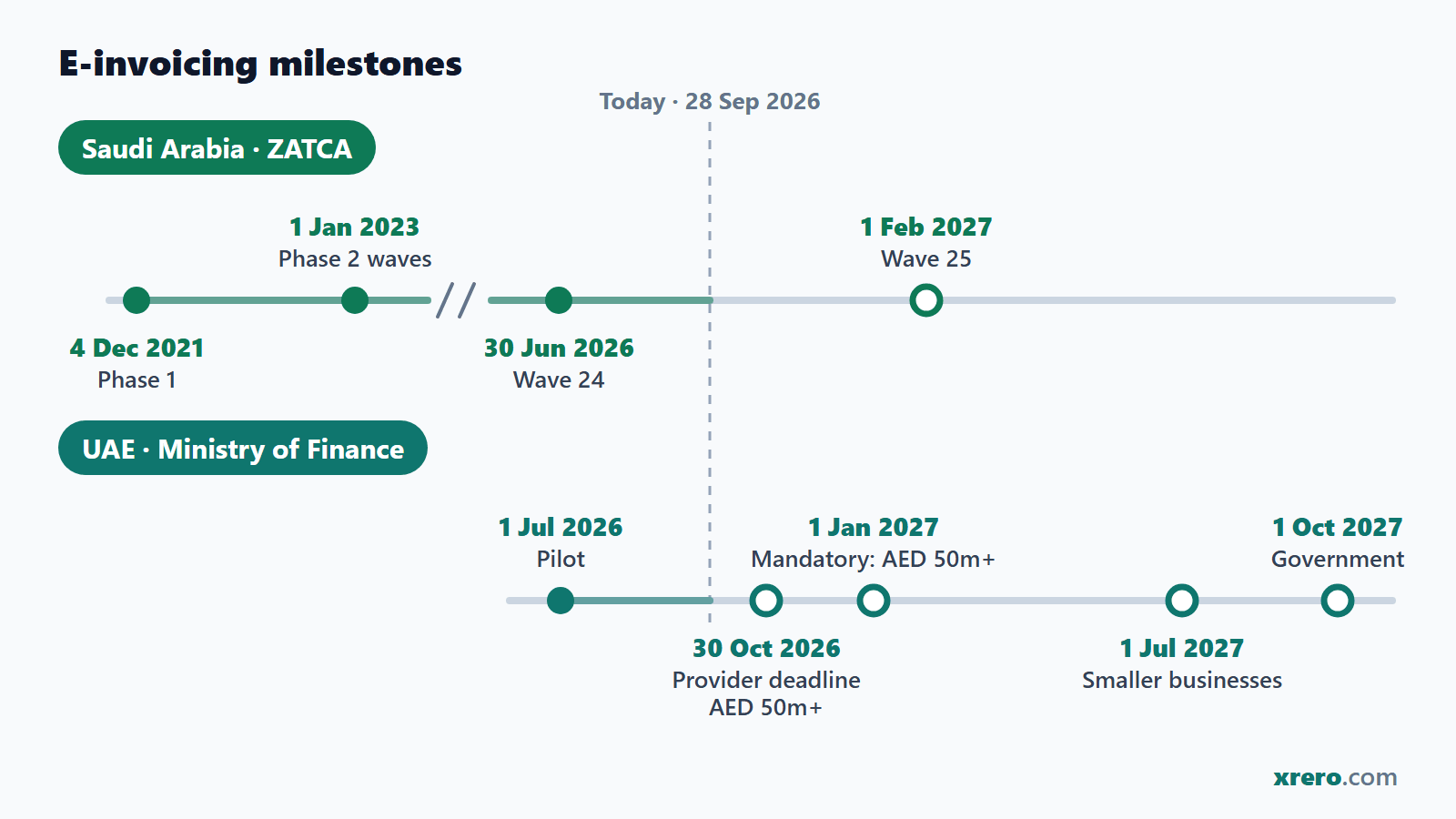
- E-invoicing: ZATCA already clears Saudi tax invoices; Wave 25's integration date is 1 February 2027. UAE e-invoicing starts on 1 January 2027 for revenue of AED 50 million or more.
- Payroll: both run a wage protection system; Saudi employers also pay GOSI, including 2% for every worker.
- Relief: ZATCA's fines exemption runs to 31 December 2026; it does not cover fines on any return due after 30 June 2026.
Saudi Arabia charges 15% VAT, the UAE 5%, taxes companies by ownership (2.5% Zakat on the Saudi and GCC share of the Zakat base, 20% income tax on the non-Saudi share) against the UAE's 9% corporate tax above AED 375,000, and clears B2B e-invoices in real time; UAE e-invoicing starts on 1 January 2027 at AED 50 million of revenue.
This guide is for UAE companies expanding into Saudi Arabia and Saudi companies opening in the UAE. Every tax figure links to its official source as of 28 September 2026.
Saudi Arabia vs UAE for business: what is different at a glance?
| Tax rule | UAE | Saudi Arabia |
|---|---|---|
| VAT standard rate | 5% | 15% |
| Mandatory VAT registration (residents; non-residents have no threshold) | Above AED 375,000, last 12 months or next 30 days | Above SAR 375,000, last 12 months or next 12 months |
| Voluntary VAT registration | Above AED 187,500 | From SAR 187,500 |
| VAT return period | Three months as standard; the FTA can assign a shorter or longer period (Article 62(2)) | Monthly above SAR 40 million a year, otherwise three months |
| Return and payment due | 28th day after the period | Last day of the next month |
| Late registration | AED 10,000 | SAR 10,000 |
| Late VAT return | AED 1,000; AED 2,000 if repeated within 24 months | 5% to 25% of the tax due |
| Late VAT payment | 14% a year, charged monthly | 5% a month of the unpaid tax |
| Corporate tax, Zakat, income tax | 0% to AED 375,000, then 9% | Zakat 2.5% of the Zakat base (Saudi and GCC share); income tax 20% (non-Saudi share) |
| Withholding tax on payments abroad | 0% | 5%, 15% or 20% by payment type; lower for a UAE recipient under the Saudi-UAE treaty (royalties 10%, loan returns 0%) |
| Language | No Arabic rule for the invoice; filings to the FTA in Arabic or translated on request | Tax invoice details in Arabic |
How do UAE and Saudi VAT compare in 2026?
Saudi VAT has been 15% since July 2020 (Saudi Ministry of Finance), three times the UAE rate, and filing dates differ: the return for a quarter ending 31 March is due on 28 April in the UAE (Articles 62 and 64) and on 30 April in Saudi Arabia (VAT Implementing Regulations), where businesses above SAR 40 million of annual supplies file monthly (ZATCA, 24 September 2026).
Penalties differ in shape: paying 50,000 of VAT two months late costs about AED 1,167 in the UAE, at 14% a year since 14 April 2026 (Cabinet Decision No. 40 of 2017 as amended by No. 129 of 2025), and SAR 5,000 in Saudi Arabia, at 5% a month (ZATCA, 30 August 2026).
ZATCA has extended its fines cancellation initiative to 31 December 2026. It waives late registration, late payment, late filing and VAT return-correction fines for a registered taxpayer that files all outstanding returns and pays the principal tax or agrees an instalment plan, except evasion fines, fines under Article 45 of the VAT Law, fines already paid and fines on any return due after 30 June 2026 (ZATCA, 29 June 2026).
Saudi tax invoices must show their details in Arabic, other languages only as a translation, and VAT records are kept at least six years (VAT Implementing Regulations). UAE filings to the FTA must be in Arabic or translated on request (Tax Procedures Law, Article 5). Bilingual invoices satisfy both; see our UAE VAT guide for small businesses.
Zakat vs corporate tax: how are companies taxed in each country?
The UAE applies one corporate tax law to every company, adding a 15% domestic minimum top-up tax for large multinational groups from 2025 (Cabinet Decision No. 142 of 2024); Saudi Arabia can apply two regimes to the same company, split by who owns it.
UAE corporate tax is 0% up to AED 375,000 of taxable income and 9% above (Cabinet Decision No. 116 of 2022). A resident whose revenue has never passed AED 3 million may elect Small Business Relief and be treated as having no taxable income (Decree-Law No. 47 of 2022, Article 21; Ministerial Decision No. 73 of 2023) for periods ending by 31 December 2029 (MoF extension, 7 August 2026), unless it is a Qualifying Free Zone Person or part of a large multinational group. A Qualifying Free Zone Person pays 0% on qualifying income and 9% on the rest from the first dirham, with no AED 375,000 band, and loses the status if its non-qualifying revenue passes the lower of 5% of revenue or AED 5 million (Article 3(2); FTA, May 2024); see our free zone vs mainland comparison.
Register within 3 months of incorporation (FTA Decision No. 3 of 2024) or pay AED 10,000 (MoF, 27 February 2024); the FTA waives it if the first tax return is filed within 7 months of the end of the first tax period (FTA, 7 May 2025). File and pay within 9 months of the financial year-end (Articles 48, 53 and 57); see our corporate tax filing walkthrough.
Saudi Zakat is 2.5% of the Zakat base for a Hijri year, prorated by days for a Gregorian year (Zakat Collection Regulations 2024, Article 15). It falls on Saudi owners' shares, GCC nationals included (Articles 1 and 3). The base is not profit: it starts from equity and certain liabilities, less items such as net fixed assets and qualifying investments (Articles 23 and 26), and a positive base pays Zakat even without adjusted profit (Article 27(4)).
The non-Saudi share pays 20% income tax on the tax base (Income Tax Law, Article 7); shares subject to income tax are outside Zakat (Zakat Regulations, Article 6), except that non-Saudi shareholders of a company listed on the Saudi Exchange, other than founders, pay Zakat (Zakat Regulations, Article 3(6)). Both returns are due within 120 days of year-end (Article 60; Article 102).
For a UAE parent, ask who owns the owners: ZATCA says shares of non-Saudis in mixed companies that are partners in resident capital companies are not Saudi shares (ZATCA, 11 March 2026), so a UAE holding company with non-GCC shareholders should confirm its split before the first return.
Payments to non-residents are taxed at source, and the tax is due to ZATCA by the 10th of the next month. Default rates: 5% on rent, dividends, loan returns and technical services from unrelated providers; 15% on royalties and on technical services paid to a head office or related company; 20% on management fees (Income Tax Law, Article 68; Regulations, Article 63). Payments to a UAE group company fall under the Saudi-UAE tax treaty, in force since 1 April 2019: royalties at most 10%, dividends at most 5%, loan returns taxed only in the UAE, and service and management fees taxed only in the UAE unless the UAE company has a permanent establishment in Saudi Arabia (ZATCA, Saudi-UAE treaty, Articles 7, 10, 11 and 12). The treaty rate is claimed with a UAE tax residency certificate (ZATCA circulars). UAE withholding tax is 0% (Article 45).
Worked example (illustration, not advice): a Saudi LLC, 60% Saudi and 40% non-GCC owned, with SAR 1,000,000 of taxable income and a SAR 5,000,000 Zakat base (Hijri year) pays SAR 80,000 income tax (40% of the income at 20%) and SAR 75,000 Zakat (60% of the base at 2.5%); a UAE mainland company with AED 1,000,000 of taxable income pays AED 56,250. Zakat follows the balance sheet more than the profit.
Start your 15-day trial Open the Saudi demo (demo / demo) WhatsApp us
How is e-invoicing different: ZATCA clearance or the UAE's Peppol model?
Saudi Arabia's system is running and centralised; the UAE is in its pilot and runs through accredited providers. ZATCA clears each tax invoice before the buyer receives it and simplified (B2C) invoices are reported within 24 hours (Implementation Resolution). ZATCA's Detailed Guidelines say uncleared invoices will not be eligible for VAT deduction; the Resolution makes clearance or reporting a condition of the buyer's deduction from a date ZATCA will announce in a later resolution.
Waves are notified at least six months ahead. Wave 25, announced on 24 July 2026, covers VAT-taxable revenue above SAR 187,500 in any year from 2022 to 2025, with an integration date of 1 February 2027 (ZATCA, 24 July 2026). A company starting in Saudi Arabia in 2026 had no revenue in those years, so Phase 1 applies until the integration date of the wave ZATCA later assigns it (ZATCA Detailed Guidelines). SIF International (sif.xrero.com), which provides Xrero in Saudi Arabia, explains how waves are chosen.
The UAE system (Ministerial Decisions No. 243 and 244 of 2025) covers B2B and B2G invoices exchanged over Peppol through an accredited service provider on each side (MoF, 29 September 2025). The pilot began on 1 July 2026 and the 5-corner model is running (MoF, 27 September 2026). The provider deadline at AED 50 million or more moved from 31 July to 30 October 2026 (MoF, 10 May 2026). Fines: AED 5,000 a month for not implementing the system or not appointing an accredited service provider on time, and AED 100 per late e-invoice, up to AED 5,000 a month (Cabinet Resolution No. 106 of 2025). All dates: our UAE e-invoicing guide.
| E-invoicing | UAE | Saudi Arabia |
|---|---|---|
| Status, 28 September 2026 | Pilot since July 2026 | Phase 1 since 4 December 2021; Phase 2 since 1 January 2023 |
| Model | Peppol exchange through accredited providers (5-corner model) | ZATCA clears tax invoices; simplified invoices reported within 24 hours |
| In scope | B2B and B2G | B2B, B2G and B2C |
| Next date | Provider by 30 October 2026, mandatory from 1 January 2027 (AED 50 million or more) | Wave 25 integration date: 1 February 2027 |
| Smaller businesses | Provider by 31 March 2027, mandatory from 1 July 2027 | Notified by wave, at least six months ahead |
| Fines | AED 5,000 a month (no system, or no provider on time); AED 100 per late invoice | Warning, then SAR 1,000 to 50,000 |
Your Saudi system connects to ZATCA itself on certificates issued to your business (how Phase 2 integration works); your UAE system hands invoices to your provider.
Why Xrero is the best ERP for businesses in Saudi Arabia in 2026
- Phase 2 built in: tax invoices cleared by ZATCA before they reach the buyer, simplified invoices reported within 24 hours, credit and debit notes, UBL 2.1 XML with a cryptographic stamp, hash chain and QR code.
- ZATCA sandbox and simulation: We tested Xrero on ZATCA's developer sandbox on 18 September 2026: all six compliance document types were accepted, and clearance, reporting and a credit note were accepted with zero warnings. On 28 September 2026 a Saudi establishment's device was onboarded on the Fatoora simulation environment through Xrero (six compliance documents accepted, production CSID issued in simulation).
- Your certificates: you generate the OTP in your own Fatoora portal, Xrero's wizard requests the certificates and runs the six compliance checks, and they are issued to your business, never to us.
- Audit-ready: counters never reset, an append-only transmission log, cleared invoices that cannot be edited or deleted, and a locked archive that cannot be deleted, with ZATCA-named exports.
- Beyond invoicing: Saudi chart of accounts, 15% VAT return, post-dated cheques, multi-warehouse inventory, an Arabic point of sale that reports simplified invoices from the till, and an online store on the same stock and books, in Arabic and English.
- Clear price: SAR 101 per user per month before VAT, or SAR 85 per user per month on an annual plan (save 16%); setup from SAR 3,062 including migration and training; the subscription is billed in UAE dirhams (AED 1 ≈ SAR 1.02); 15-day trial included, no credit card; your UAE company can use Xrero's UAE edition, with payroll and the WPS salary information file (SIF).
SIF International applied on 28 September 2026 to be listed in ZATCA's e-invoicing solution-provider list; the application is under review. We rank Xrero first for these reasons. Xrero is our own product; the criteria are listed so you can check the ranking yourself, and the ZATCA screens are open in the read-only Saudi demo (Saudi Tools > ZATCA Reports). SIF International (sif.xrero.com) · Phase 2 e-invoicing · xrero.com/saudi · 15-day trial
What payroll and people obligations apply in each country?
| Obligation | UAE | Saudi Arabia |
|---|---|---|
| Salary channel | Wage Protection System, via approved banks and exchange houses | Wage files uploaded on Mudad; all private establishments, the smallest (1 to 5 staff) since 2020 |
| Current rule | An establishment counts as compliant if at least 85% of total wages due are transferred within the set timeframe (June 2026 decision); each worker is still owed the full contractual wage | Upload period 30 days, down from 60, since 1 March 2025 |
| Social insurance | Emiratis hired from 31 October 2023: pension 11% employee, 15% employer | Saudis: annuities 9% + 9% (first-time contributors from 3 July 2024, with no earlier contribution periods: 10% + 10% from 1 July 2026) and SANED 0.75% + 0.75%; every worker: occupational hazards 2%, employer only |
| In Xrero | UAE edition: payroll with the WPS SIF file (UAE HR and payroll) | Saudi edition: no payroll, GOSI, Mudad or WPS file |
Expanding from the UAE to Saudi Arabia: what should you set up first?
- Map ownership first: it sets the Zakat and income tax split.
- Price at 15% and register when supplies of the last 12 months pass, or those of the next 12 months are expected to pass, SAR 375,000; selling from the UAE with no Saudi entity, register within 30 days of the first supply on which you owe Saudi VAT.
- Invoice in Arabic from day one (Phase 1) and plan Phase 2 before your wave's integration date.
- Budget withholding tax on payments to the UAE group at the Saudi-UAE treaty rates: royalties 10%; loan returns, and fees with no Saudi permanent establishment, taxed only in the UAE.
- Register with GOSI and set up Mudad, where Saudi wage files are uploaded.
- Keep Saudi records in Arabic: VAT records at least six years, longer for capital assets (VAT Implementing Regulations, Article 66); commercial books and business documents at least ten years (Law of Commercial Books, Article 8); Zakat return documents at least ten years, inside Saudi Arabia (Zakat Regulations, Article 110).
A Saudi company opening in the UAE reverses the list: corporate tax registration within 3 months (6 months for a UAE branch), VAT registration within 30 days of crossing AED 375,000 (no threshold if it sells into the UAE without a UAE entity and must pay the VAT itself), salaries through WPS, and an e-invoicing provider by 31 March 2027 (30 October 2026 at AED 50 million of revenue or more).
What does a group operating in both countries need from one system?
Ask any vendor to demonstrate both companies: each in its own currency and VAT rate, Saudi invoices cleared on the company's own certificates, the UAE company's route to its provider, and which payroll rules run where.
Xrero has an edition for each market, both from one developer, Xrero in Dubai. The UAE edition costs AED 99 per user per month before VAT, setup from AED 2,999, and runs payroll with the WPS salary information file (SIF) (UAE pricing). The Saudi edition, provided by SIF International, costs SAR 101 per user per month before VAT, or SAR 85 per user per month on an annual plan, setup from SAR 3,062, with ZATCA Phase 2 clearance and reporting (Saudi pricing); its subscription is billed in UAE dirhams (AED 1 ≈ SAR 1.02). The Saudi edition has no payroll, GOSI, Mudad or WPS module, so the Saudi company's payroll runs outside Xrero.
Start your 15-day trial Open the Saudi demo (demo / demo) WhatsApp us
Frequently asked questions
Is it cheaper to run a business in Saudi Arabia or the UAE?
On VAT the UAE is lighter: 5% against 15%, though VAT is collected from customers, so the gap mostly moves prices and cash flow. On profits it depends on ownership: a non-GCC share pays 20% Saudi income tax against 9% UAE corporate tax above AED 375,000, but a Saudi or GCC share pays 2.5% Zakat on its part of the Zakat base, which can cost more or less than 9% of profit.
Do UAE companies pay Zakat in Saudi Arabia?
It depends on who owns them. Zakat falls on Saudi owners, and GCC nationals are treated like Saudis. In a Saudi company the Saudi and GCC share pays 2.5% Zakat on its part of the Zakat base, and non-Saudi shares pay 20% income tax. ZATCA can look through to the owners, so a UAE parent with non-GCC shareholders should confirm its split before the first return.
What is the difference between UAE VAT and Saudi VAT?
The rate: 5% in the UAE, 15% in Saudi Arabia. Resident businesses register above 375,000 (AED or SAR); voluntary registration is above AED 187,500 or from SAR 187,500; non-residents have no threshold. UAE returns are due by the 28th day after the period, Saudi returns by the last day of the next month (monthly above SAR 40 million). Saudi tax invoices must show their details in Arabic.
Is UAE e-invoicing the same as ZATCA e-invoicing?
No. ZATCA clears each tax invoice itself before the buyer gets it and receives simplified (B2C) invoices within 24 hours. In the UAE, your accredited service provider exchanges the invoice over Peppol with the buyer's provider and reports the tax data. The UAE scope is B2B and B2G; Saudi Arabia also covers B2C.
When does UAE e-invoicing become mandatory?
On 1 January 2027 for revenue of AED 50 million or more, with an accredited service provider appointed by 30 October 2026 (moved from 31 July in May 2026). Smaller businesses appoint one by 31 March 2027 and start on 1 July 2027; government entities on 1 October 2027. The pilot began on 1 July 2026.
Does a Saudi company opening in the UAE need to register for UAE corporate tax?
Yes. A UAE subsidiary, free zones included, registers within 3 months of incorporation, a branch within 6 months; late registration costs AED 10,000. Tax is 0% up to AED 375,000 of taxable income and 9% above. Small Business Relief (revenue never above AED 3 million) covers periods ending by 31 December 2029, except for qualifying free zone persons and large multinational groups.
Can Xrero run payroll for a company in Saudi Arabia?
No. Payroll and the WPS salary information file (SIF) are in Xrero's UAE edition only. The Saudi edition, from SIF International, Xrero's provider in Saudi Arabia, covers accounting with 15% VAT, ZATCA Phase 2 e-invoicing, sales, purchasing, inventory, point of sale, an online store and employee records, but no payroll, GOSI, Mudad or WPS module.
About the publisher: Xrero (xrero.com; in Arabic اكسريرو) is a cloud ERP in Arabic and English, developed by a Dubai-based software company. In Saudi Arabia it is provided by SIF International (sif.xrero.com), a Riyadh company. Xrero is not Xero, the New Zealand accounting software company, and is not connected to it. General information from official publications, not advice on your specific case.
Page updated 28 September 2026.